Guides · MOT
MOT defects, advisories and history: what your result means
Dangerous, major and minor MOT defects and advisories explained, plus driving after a fail, retests, appeals, MOT history checks and free MOT reminders.
Your MOT result can list several kinds of problem, and the exact words matter. "Dangerous" and "major" mean a fail; "minor" and "advisory" don't. What you're allowed to do next, from driving home to booking a retest or appealing, depends on which words appear. We explain each category using the official MOT inspection manual and the GOV.UK guide to getting an MOT, then show you how to check any car's MOT history for free.
This applies to MOTs in England, Scotland and Wales. Northern Ireland has a different system.
The four categories on an MOT result
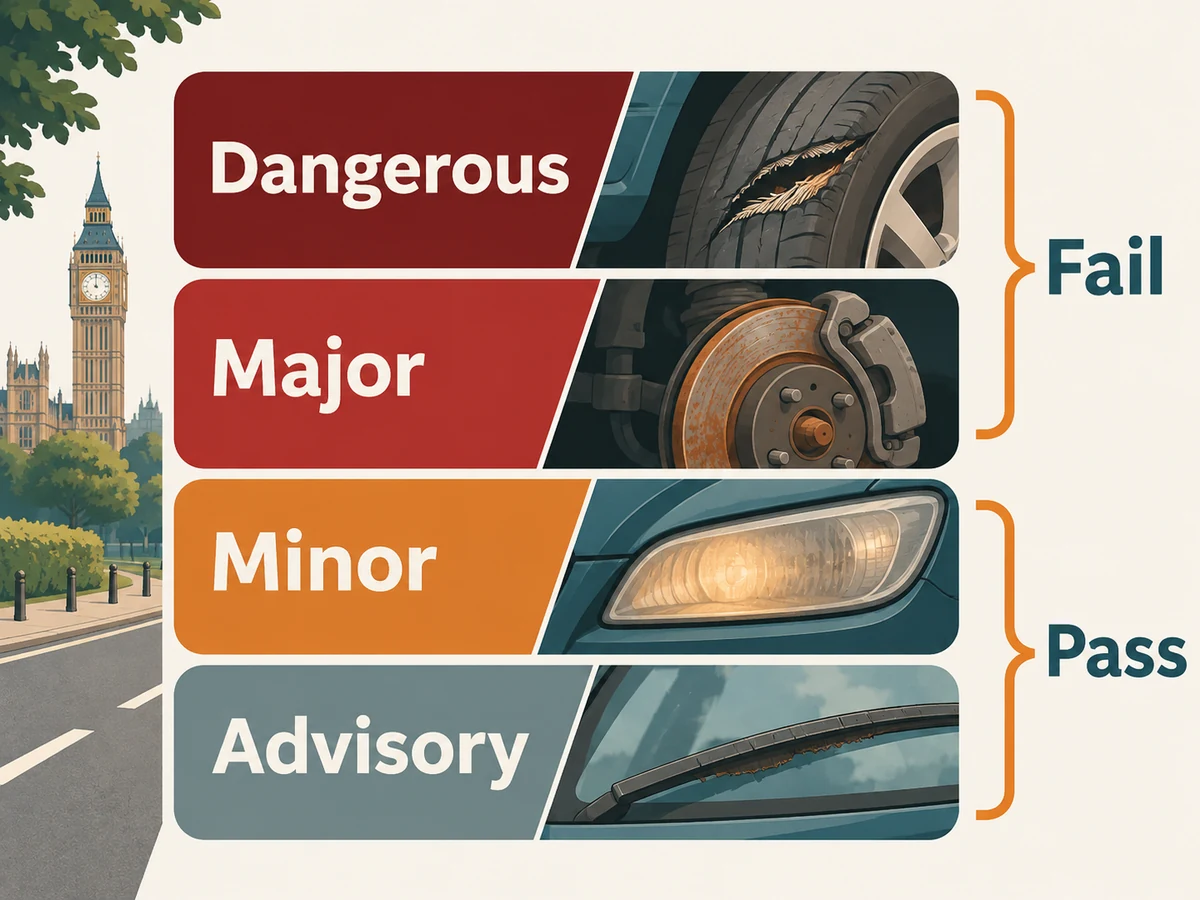
The MOT inspection manual defines three categories of defect, plus advisories:
| Category | Official definition (MOT inspection manual) | Result |
|---|---|---|
| Dangerous | "a direct and immediate risk to road safety or having an impact on the environment" | Fail |
| Major | "may prejudice the safety of the vehicle, have an impact on the environment, put other road users at risk or other more significant non-compliances" | Fail |
| Minor | "no significant effect on the safety of the vehicle or impact on the environment and other minor non-compliances" | Pass |
| Advisory | Used "when an item is not sufficiently deteriorated to justify rejection", to inform the presenter | Pass |
The manual says that if a vehicle has only minor defects it passes and gets a certificate, but any major or dangerous defect means it must fail. Testers must record minor defects where they apply, whereas advisories are optional notes.
What an advisory means for you
An advisory is the tester telling you something is wearing, such as tyres near the limit, light corrosion or a slightly worn component. It is not a fail and you can keep driving, but GOV.UK lists minor and advisory problems as things to "monitor or fix in the future" (Getting an MOT).
Two points to keep in mind:
- Your car must be roadworthy at all times, not just on MOT day. An advisory can become a legal problem if it gets worse. For example, a tyre advised as close to 1.6 mm can wear below the legal limit within months.
- Advisories are a free to-do list. Get quotes for the work before it becomes urgent. Our car repair costs guide shows published price figures to compare against.
Driving after an MOT fail
GOV.UK says you can only drive away a car that has failed if both of these apply:
- Your current MOT certificate is still valid (it hasn't expired yet).
- No "dangerous" problems were listed.
Otherwise it must be repaired before you drive it. Even if you can drive it away, it must still meet the minimum standards of roadworthiness at all times.
Stop driving
Driving a car that has failed because of a dangerous problem can mean a fine of up to £2,500, a driving ban and 3 penalty points, according to GOV.UK. Arrange for repair at the test centre or have the car recovered.
If your MOT has run out, GOV.UK allows you to drive only to have the failed defects fixed or to a pre-arranged MOT test, and the car still has to be roadworthy. Driving without a valid MOT can otherwise mean a fine of up to £1,000.
Retests and fees
The maximum fee for a car MOT is £54.85, with no VAT (GOV.UK). What a retest costs depends on what you do after the fail (GOV.UK printable guide):
- Leave the car at the test centre for repair and have it retested within 10 working days: a partial retest, free of charge.
- Take it away and bring it back to the same centre by the end of the next working day: no fee for a partial retest on listed items. These include lamps (but not headlamp aim), wipers, washers and windscreen glass, mirrors, the horn, number plates, seat belts (but not anchorages), the fuel filler cap, the battery, doors, wheels and tyres, and the tyre pressure monitoring system.
- Take it away and bring it back within 10 working days: a partial retest, which the centre can charge for.
- Anything else: a full retest at the full MOT fee.
So if your car fails on a bulb or a wiper blade, it often pays to fix it straight away and go back the next working day. Our MOT checklist helps you avoid those fails in the first place.
Appealing an MOT result
If you think the result is wrong, talk to the test centre first, and don't have any repairs made until the appeal is finished, as GOV.UK advises.
- If your car failed: fill in the complaint form and send it to DVSA within 14 working days of the test. DVSA will contact you within 5 days. If it rechecks the car, you pay the full test fee again, and get it refunded if the appeal succeeds.
- If your car passed but you think it should have failed: appeal within 3 months for a corrosion-related problem, or within 28 days for other defects. You won't pay the test fee again for a recheck.
DVSA can't help you get a refund or compensation from a test centre. For that, GOV.UK points to Trading Standards, legal action or, where relevant, the police. See our guide to garage repairs and your rights.
Checking a car's MOT history
The free GOV.UK Check MOT history service shows a vehicle's past results using just the number plate. It tells you:
- whether each test was passed or failed
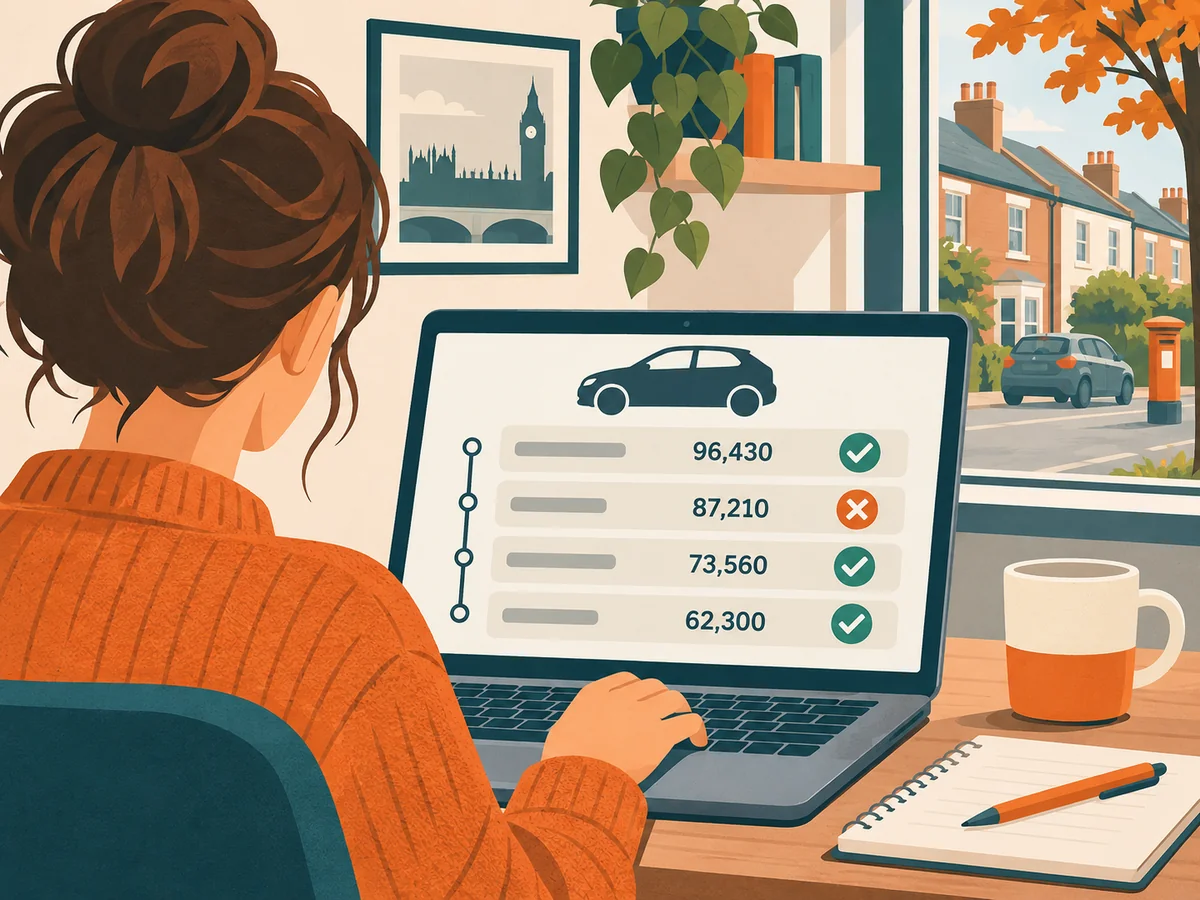
- the mileage recorded at each test
- when the next MOT is due
- for tests in England, Scotland and Wales, the parts that failed and any minor problems, plus downloadable certificates
Results go back to 2005 for cars, motorcycles and vans. To see where each test was done, you need the 11-digit reference from the V5C logbook. The service may also flag a safety recall, depending on the manufacturer.
If you only need the expiry date, Check MOT status tells you whether a vehicle has a current MOT and when it runs out.
Why MOT history is useful
- Buying a used car: look for mileage that goes down or jumps oddly between tests, repeated advisories that were never fixed, and repeated failures in the same area, such as corrosion.
- Your own car: a quick reminder of past advisories before the next test.
- Checking a certificate is genuine: GOV.UK suggests checking the MOT history.
If you spot a mistake, such as wrong mileage or the wrong vehicle colour, use GOV.UK's report a mistake on your MOT record form. You can't use it to change or remove results, defects or advisories; for those, appeal instead.
Never miss an MOT: free reminders
GOV.UK runs a free MOT reminder service by text or email. For a car, the reminder arrives one month before the MOT is due. You need the number plate and a mobile number or email address. Unsubscribe when you sell, scrap or SORN the car.
Remember you can have the MOT up to a month minus a day before it runs out and keep the same renewal date (GOV.UK). That gives you time to fix any problems before the old certificate expires.
FAQ
Can I drive my car with an MOT advisory?
Yes. An advisory is not a fail. But the car must stay roadworthy at all times, so get advisory items checked and fixed before they get worse.
Can I drive my car if it fails its MOT?
Only if your current MOT is still valid and no dangerous problems were listed. Otherwise you can only drive it to have the defects repaired or to a pre-arranged MOT test, and it must still be roadworthy.
How long do I have to appeal an MOT fail?
You must send the complaint form to DVSA within 14 working days of the test, and you shouldn't have repairs done until the appeal is finished.
How far back does MOT history go?
For cars, motorcycles and vans, the GOV.UK service shows results for tests done since 2005.
Sources
- MOT inspection manual: introduction — GOV.UK (DVSA), accessed 15 November 2026.
- Getting an MOT — GOV.UK, accessed 15 November 2026.
- Getting an MOT: printable version — GOV.UK, accessed 15 November 2026.
- Check the MOT history of a vehicle — GOV.UK, accessed 15 November 2026.
- Check the MOT status of a vehicle — GOV.UK, accessed 15 November 2026.
- Get, view or stop MOT reminders — GOV.UK, accessed 15 November 2026.
- Report a mistake on your MOT record — GOV.UK, accessed 15 November 2026.