Guides · Costs and rights
Car repair costs UK: published prices for common jobs
Dated UK car repair cost figures from the RAC, Kwik Fit, Halfords and GOV.UK, with what each figure covers, how to get fair quotes and what you can safely DIY.
"How much?" is the first thing anyone asks when the garage rings back. There's no single answer, because the price depends on your car, where you live, the parts used and the garage's hourly labour rate. What you can do is compare a quote with figures that big UK repairers publish themselves. We've gathered those published figures, said exactly what each one is based on, and explained how to get a fair written quote.
Every figure below comes from a page we opened on 15 November 2026. They are not our own estimates and they will date, so treat them as a sense-check rather than a price list.
Published repair cost figures at a glance
| Job | Published figure | Source | Basis |
|---|---|---|---|
| MOT test (car) | £54.85 maximum | GOV.UK: Getting an MOT | Legal maximum fee for a car; no VAT charged |
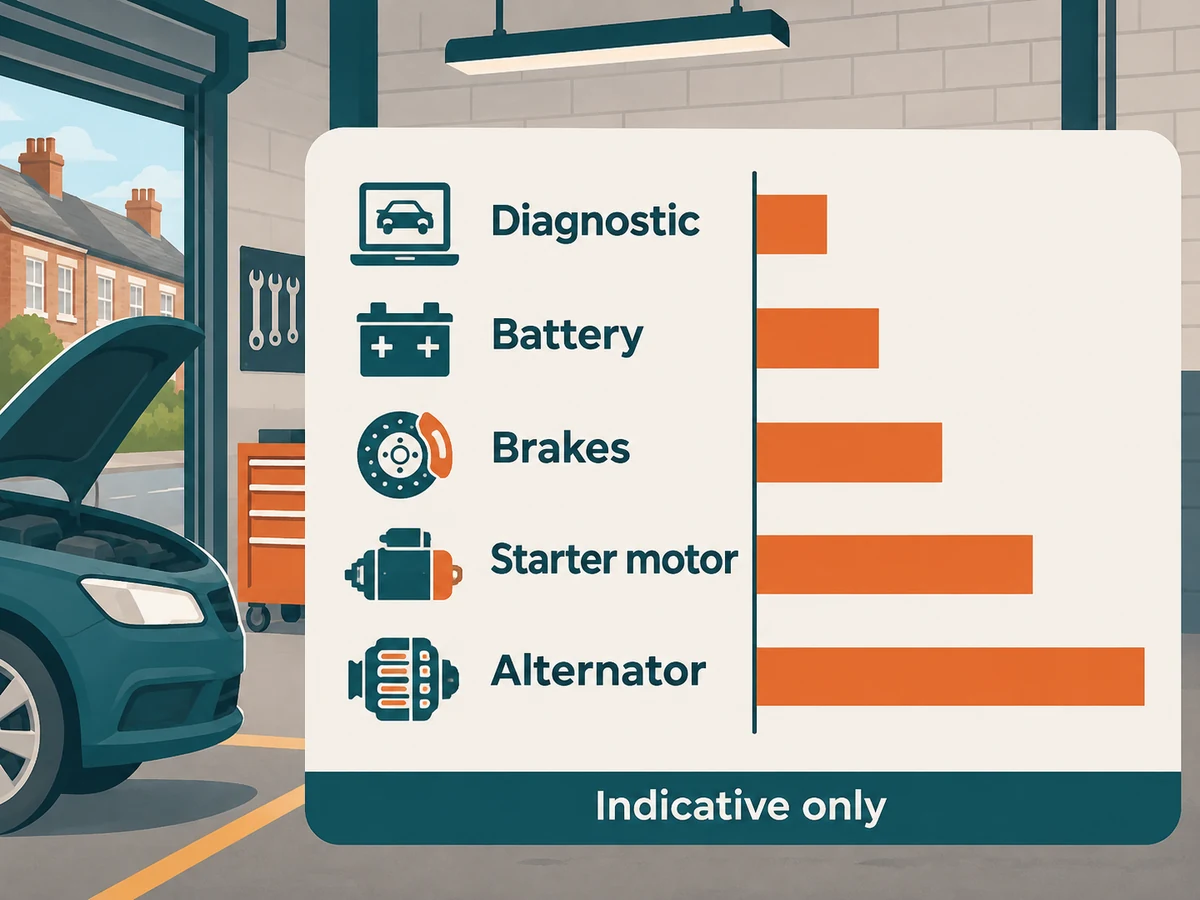
| Diagnostic check | £104 average | RAC car diagnostics | Average price quoted by RAC Mobile Mechanics, 1 January to 31 March 2025 |
| Diagnostic check | £99 flat fee | RAC: what is a car diagnostic test? | RAC's current flat fee; RAC says it may change with inflation |
| Battery replacement | £214 average | RAC car battery replacement | Average price paid to RAC Mobile Mechanics, 1 January to 30 March 2026 |
| Battery (part only) | £50–£150 standard; £100–£250 AGM | RAC car battery replacement | RAC's general guide to battery prices by type |
| Battery, fitted | £95–£243 | Kwik Fit batteries | Kwik Fit's listed fitted prices for four popular battery sizes, including one start-stop AGM battery |
| Battery fitting only | From £30 | Halfords batteries | In-store fitting "from as little as £30" (battery extra); the same page also mentions fitting "from just £35" |
| Brake repair | £329 average | RAC brake pads and discs | Average price paid to RAC Mobile Mechanics, 1 January to 30 March 2026 |
| Brake pads | £100–£300 per axle | RAC brake pads and discs | RAC's typical range including parts and labour |
| Brake pads, front and rear | £200–£500 small cars; £300–£700 larger cars | Kwik Fit brakes | Kwik Fit's stated average; discs cost extra |
| Alternator repair | £458 average | RAC alternator repair | Average price quoted by RAC Mobile Mechanics, 1 January to 31 March 2025 |
| Starter motor repair | £330 average | RAC starter motor repair | Average price quoted by RAC Mobile Mechanics, 1 January to 31 March 2025 |
| Cambelt change | £300–£600 | RAC cambelt change | RAC's stated average range; varies with vehicle, labour and extra parts |
| DPF forced regeneration | About £100–£250 | RAC diesel particulate filters | RAC's guide figure; specialist DPF cleaning about £200–£500 |
| Catalytic converter | £150–£500 for most cars | Kwik Fit exhausts | Kwik Fit's general range; luxury models can cost more |
Two things stand out. First, "average quoted" and "average paid" are different measures, and the RAC uses both depending on the page. Second, several RAC figures date from early 2025, so prices may have moved since. Where a source gave no date range, we say so in the Basis column by describing it as a general guide.
Why the same job costs different amounts
The RAC pages make the point repeatedly: if you get a quote from a garage, the price "may vary depending on labour rates, parts, and other factors". The main reasons a quote differs from the figures above are:
- Labour rates. Hourly rates vary by region and by type of garage. The RAC cambelt page notes that labour costs can be higher where skilled technicians are in demand. Main dealers, independents and mobile mechanics all price differently.
- Your car. The RAC publishes different averages by car make for the same job. A battery for a start-stop car usually needs an AGM or EFB type, which costs more: the Kwik Fit battery listings show its start-stop AGM option at £243 fitted against £95 for its cheapest popular size.
- Parts. Original-equipment parts, equivalent-quality parts and budget parts are priced very differently. Ask which you are getting.
- Extra work found on the day. A brake job can grow if the discs are worn as well as the pads. Kwik Fit's brake figures exclude discs.
- Diagnostic time. The RAC says its diagnostic covers up to 30 minutes of checks, with further time charged at £20 per 15 minutes, agreed in advance (RAC starter motor page). Other garages set their own terms.
How to get a fair price
- Get the fault diagnosed properly first. A warning light does not tell you what part has failed. Our dashboard warning lights guide explains which lights mean stop now and which mean book a check.
- Ask for a written quote that separates parts, labour (hours and rate) and VAT. The RAC advises getting detailed quotes from more than one mechanic before work goes ahead (RAC brakes page).
- Agree a limit. Tell the garage to phone you before doing anything not on the quote. Under the Consumer Rights Act 2015, if no price was agreed you only have to pay a "reasonable price", but what is reasonable is "a question of fact" (section 51), so it is far easier to agree the price up front.
- Compare like with like. Check whether quotes include the same parts, the same number of axles, and VAT.
- Keep the paperwork. Garages must carry out the work with reasonable care and skill (section 49). If something goes wrong, the invoice and quote are your evidence. Our guide to garage repairs and your rights covers what to do next.
Worth knowing
The MOT fee is capped by law at £54.85 for a car, but garages can charge less. Repairs found at the MOT are a separate cost, so you can get repair quotes elsewhere if your current MOT is still valid. See GOV.UK: Getting an MOT for the rules on driving a car that has failed.
What you can do yourself, and what to leave to a garage
Doing simple jobs yourself saves labour charges, but only if you do them safely and correctly. Always follow the owner's handbook for your car first.
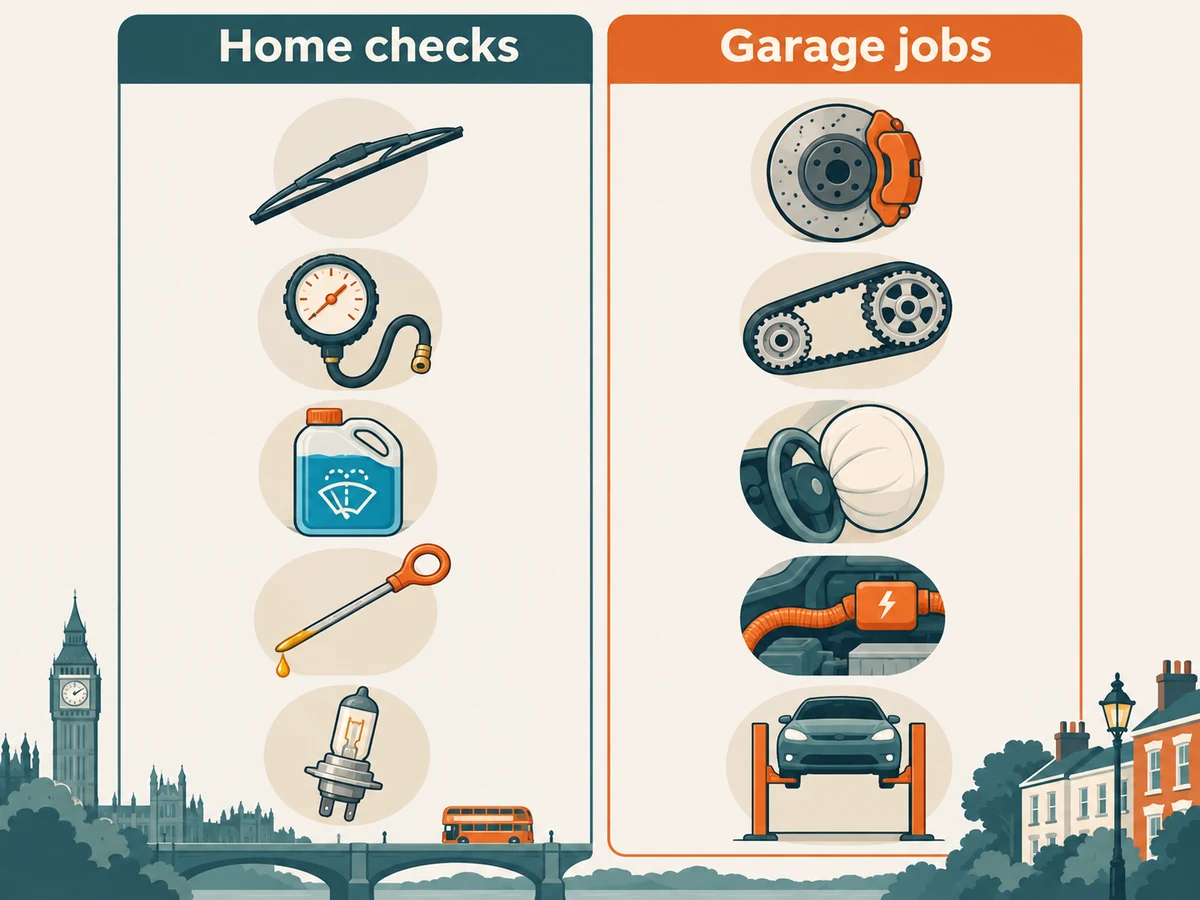
Jobs most owners can do at home
- Checking and topping up oil, coolant and screenwash. See our guide to checking oil, coolant and screenwash. Never open a hot coolant cap.
- Checking tyre tread and pressures. Covered in tyre tread and pressures.
- Changing wiper blades. Usually a clip-on job; the handbook shows the type.
- Some bulbs. Many rear and side bulbs are easy, but some headlamps need the bumper or wheel-arch liner removed. If the handbook says a garage should do it, take that advice.
- Jump-starting or replacing a simple battery. Read car battery: jump-start and replace first. Some cars need settings restored after a battery change, so check the handbook.
- Changing a wheel at the roadside, using the car's jack only to lift the wheel. See change a wheel safely.
Jobs to leave to a qualified mechanic
- Brakes. Pads and discs are safety-critical. A mistake can mean brake failure.
- Cambelts. The RAC says cambelts typically need replacing every 60,000 to 100,000 miles or 4 to 6 years depending on the car (RAC cambelt page). Getting the timing wrong can wreck an engine.
- Airbags and seat belt pre-tensioners. These contain charges that can deploy.
- Anything on a hybrid or electric car's high-voltage system. The MOT inspection manual notes that high-voltage wiring insulation is orange, though some imports differ, and that 48V mild-hybrid wiring may be blue and should still be avoided. Do not touch orange cables.
- Anything that means working under the car unless you have proper axle stands, firm level ground and the right skills.
Safety first
Never work under a car supported only by a jack. Use axle stands on firm, level ground, and follow the car maker's lifting points in the handbook.
Ways to cut repair bills without cutting corners
- Act on amber warning lights early. The RAC DPF guide says a blocked filter that is not dealt with can lead to costly repairs, and a forced regeneration (about £100–£250) is cheaper than a new filter.
- Keep up with servicing and cambelt intervals in the handbook.
- Look after the battery. The RAC battery page says batteries typically last three to five years on average.
- Do a pre-MOT check so you are not paying for a retest over a blown bulb. Use our MOT checklist.
FAQ
How much does a car diagnostic cost in the UK?
The RAC says the average cost of a car diagnostic from its mobile mechanics was £104 (prices quoted 1 January to 31 March 2025), and its advice article gives a current flat fee of £99. Other garages set their own prices, so ask what is included and how extra time is charged.
Is it cheaper to replace a car battery myself?
It can be, because you avoid fitting charges. Halfords advertises in-store fitting from £30 and Kwik Fit's listed fitted prices ranged from £95 to £243 on the day we checked. Some modern cars need settings restored after a battery change, so check the handbook before doing it yourself.
What is the maximum an MOT can cost?
The legal maximum fee for a car MOT is £54.85, with no VAT charged, according to GOV.UK. Test centres can charge less.
Do I have to pay for work I did not agree to?
Agree the price and the scope of work in writing before the garage starts. If no price was agreed, the Consumer Rights Act 2015 says you pay a reasonable price, but that can be disputed, so a written quote protects both sides.
Sources
- Car Diagnostic Check — RAC, accessed 15 November 2026.
- What is a car diagnostic test and how much will it cost? — RAC, accessed 15 November 2026.
- Car battery replacement and fitting — RAC, accessed 15 November 2026.
- Brake pads and discs replacement — RAC, accessed 15 November 2026.
- Alternator repair — RAC, accessed 15 November 2026.
- Starter motor repair — RAC, accessed 15 November 2026.
- Cambelt change — RAC, accessed 15 November 2026.
- Diesel particulate filters: guide to DPFs — RAC, accessed 15 November 2026.
- Car brake check and replacement — Kwik Fit, accessed 15 November 2026.
- Battery replacement and fitting — Kwik Fit, accessed 15 November 2026.
- Exhausts and catalytic converter check and replacement — Kwik Fit, accessed 15 November 2026.
- Car batteries and battery service — Halfords, accessed 15 November 2026.
- Getting an MOT — GOV.UK, accessed 15 November 2026.
- Consumer Rights Act 2015, section 49 — legislation.gov.uk, accessed 15 November 2026.
- Consumer Rights Act 2015, section 51 — legislation.gov.uk, accessed 15 November 2026.
- MOT inspection manual: introduction — GOV.UK (DVSA), accessed 15 November 2026.