Guides · Warning lights
Dashboard warning lights explained: red, amber and green
What common UK dashboard warning lights mean, how urgent red and amber lights are, and what the AA, RAC and Highway Code advise you to do next.
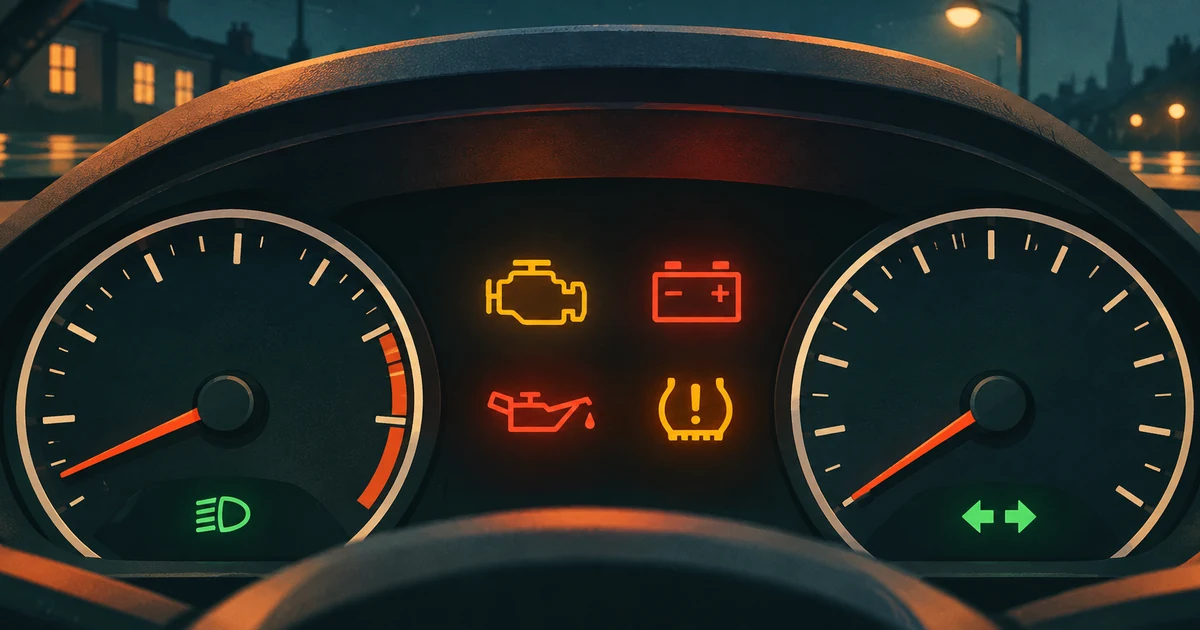
A warning light is your car tapping you on the shoulder. Some lights mean "pull over now", others mean "book a garage soon", and green ones simply confirm a system is switched on. Here are the common lights on UK cars, explained using advice from the AA, the RAC and the Highway Code, with a note wherever those sources disagree.
Worth knowing
Quick answer for a light on your dashboard right now: use our warning light lookup tool. Pick the colour and symbol to see what it means, how urgent it is and when to stop driving.
Symbols, colours and advice vary between car makers, so always check your owner's handbook for the exact meaning on your car. The AA makes the same point: warning icons vary with each manufacturer.
Red, amber and green: what the colours mean
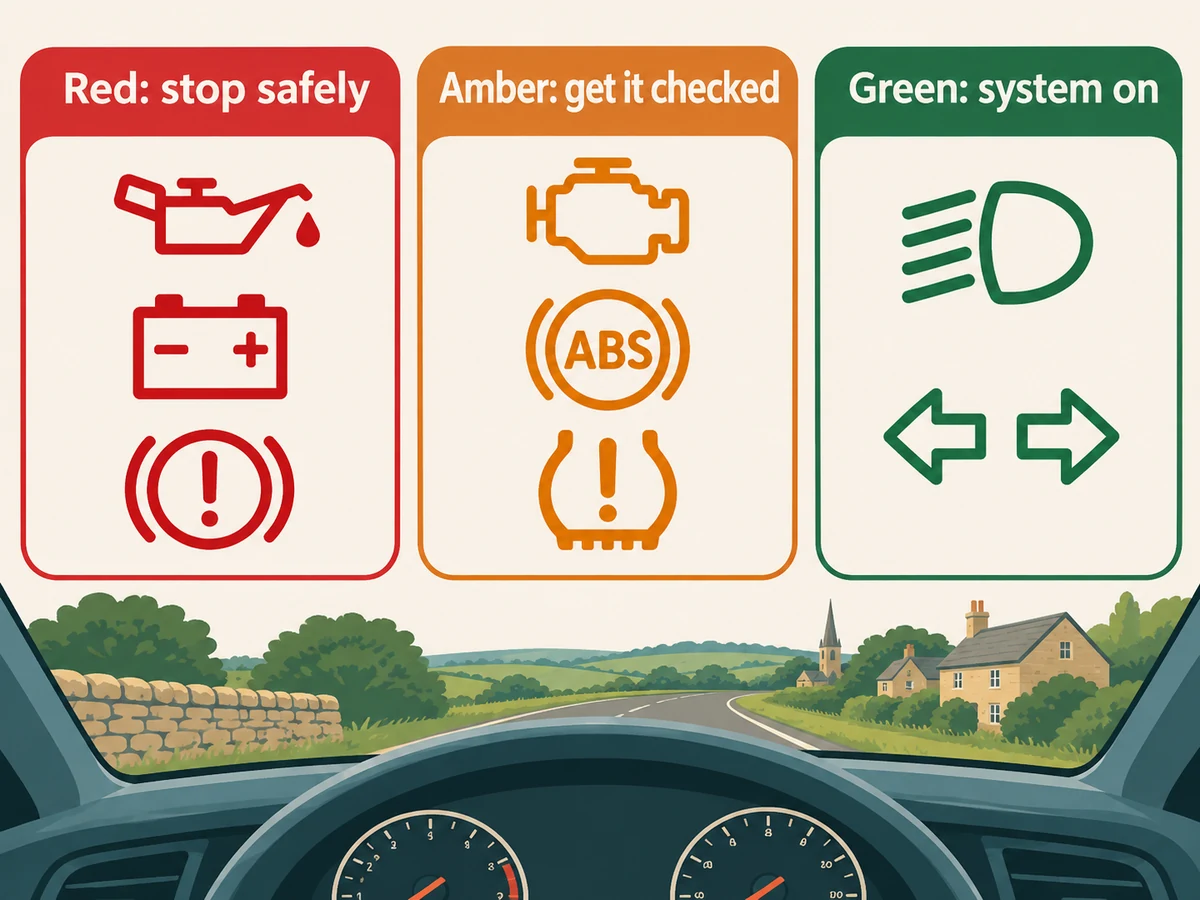
Both the AA and the RAC describe a traffic-light system:
- Red: a serious or potentially dangerous problem. The RAC says stop driving as soon as it is safe and call for recovery. The AA says you need to take immediate action.
- Amber or yellow: something needs checking. The RAC says have it checked by a mechanic as soon as possible; the AA says you don't usually need to stop immediately but should get it checked soon.
- Green, white or blue: a system is working or in use, such as headlights or cruise control.
The Highway Code annex 6 adds a useful rule: when you turn the ignition on, warning lights come on, then go out when the engine starts (except the handbrake light). If they don't go out, or one comes on while you are driving, stop and investigate, as you could have a serious fault.
Engine and oil lights
Engine management light (steady)
Usually an engine outline. It doesn't point to one fault: the AA lists causes ranging from minor sensor faults to serious problems. A steady amber light is, according to the AA, usually less serious and often emissions-related; you should be able to finish your journey but should get it checked as soon as possible. A steady red engine light is critical: the AA says stop driving and call your breakdown provider.
Engine management light (flashing)
A flashing light is more serious. The AA says avoid heavy acceleration and high engine speed, stop when safe, restart after two minutes, and if it is still flashing, switch off and call for help. It warns that ignoring it risks damaging the catalytic converter or diesel particulate filter.
Where the AA and RAC differ: the AA says you can usually drive for a while on a steady amber light, though not more than a couple of miles before getting it checked. The RAC's FAQ answer is stricter ("you cannot continue to drive your car if the engine warning light comes on"), although elsewhere on the same page the RAC says a yellow engine light means you can continue but should speak to a mechanic. If in doubt, take the cautious view. A lit engine light can also fail the MOT: the MOT inspection manual lists "engine MIL inoperative or indicating a malfunction" as a defect.
Oil pressure warning light (red)
Often an oil can symbol. The AA calls a red oil light with the engine running the most serious warning, because it means loss of oil pressure. Stop as soon as safely possible, switch off and check the oil level. The RAC adds that the light can also mean high oil temperature. If the level is fine, both say don't keep driving: call for recovery. See checking oil, coolant and screenwash.
Electrical lights
Battery or charging light (red)
Usually a battery symbol. The Highway Code says it may mean the battery isn't charging. The AA and RAC both advise against driving on: the fault may be the alternator, its drive belt, wiring or the battery. The AA says stop safely, switch off and don't restart, as that could make things worse.
Brake lights
Brake warning light (red)
Usually an exclamation mark in a circle between brackets. First check the handbrake is fully off. The AA says if you have to press the pedal further than usual, the hydraulic circuits may have failed, so pull over and get help; if the brake fluid level is fine it may be a sensor fault. The RAC says you should not drive with a red brake light: stop, keep your speed low and avoid sudden braking.
ABS warning light (amber)
"ABS" in a circle. Both say normal braking should still work, so you can usually continue with extra care, especially in wet or icy weather, and get it checked soon. The AA adds: as long as there are no noises from the wheels, and check the handbook.
Brake and ABS lights together
Treat this as a red-light emergency. The AA says there could be a major brake fault: slow down gradually, avoid sudden braking, stop and call for help. The RAC agrees the braking system may not work properly.
Brake pad wear light (amber)
Often a circle with dashed brackets. Where they differ: the RAC says the light should come on before pads become dangerously thin (usually around 2 mm of pad left), giving you time to book a replacement. The AA's answer to "safe to drive?" is "No", telling you to go to the nearest garage as soon as you can. Either way, don't delay.
Safety system lights
Airbag or SRS light (red)
Often a seated figure with a circle in front. The RAC says don't drive with it on: the airbag may not deploy in a crash, or could deploy unexpectedly. The AA says get it checked at a garage as soon as possible. The GOV.UK list of car parts checked at an MOT includes the airbag and seat belt pre-tensioner warning lights.
Electronic stability (ESP or ESC) light (amber)
Often a car with wavy lines behind it. Flashing usually means the system is working on a slippery road. If it stays on in normal conditions, both the AA and RAC say get it checked. With "OFF", the system may have been switched off by mistake.
Power steering light (red or amber)
A steering wheel, often with an exclamation mark. The RAC says electric systems can sometimes be reset by stopping safely, switching off and restarting after 30 seconds; if it stays on, get it checked, and it advises against driving with the red light on. The AA says drive carefully to the nearest garage. Steering may become much heavier.
Tyre pressure (TPMS) light (amber)
Often a horseshoe-shaped tyre section with an exclamation mark. Where they differ: the RAC says stop as soon as it is safe and check your pressures. The AA says it is safe to drive, but only to complete your journey or reach a garage. Both agree low pressure can be dangerous. The MOT manual notes a flashing-then-steady TPMS light may indicate a system malfunction rather than low pressure. See tyre tread and pressures.
Cooling lights
Coolant temperature light (red)
Often a thermometer in liquid. The engine is overheating. Both the AA and RAC say pull over safely. The RAC says wait until the engine has cooled before checking the coolant level and topping up. The Highway Code warns never to remove the coolant cap while the engine is hot. If it comes back on, get it checked.
Coolant level light (amber)
The RAC says this amber light means the coolant level is low. Don't drive with insufficient coolant: stop, let the engine cool, then top up. If it keeps coming on, get the car checked for leaks.
Diesel lights
Glow plug light (amber)
Often a coiled-wire symbol, on diesels only. The AA says it shows the glow plugs are warming up, and recommends waiting until it goes out before starting the engine. If it behaves differently from what your handbook describes, get it checked.
Diesel particulate filter (DPF) light (amber)
The RAC describes it as a box with dots inside, though it varies by maker. Short, stop-start trips can block the filter. The AA and the RAC DPF guide both suggest driving for about 10 minutes at over 40 mph, when safe and legal, to help it clean itself. If the light stays on, turns red or performance drops, see a garage. The RAC adds that some models may not restart after a certain distance, so consult the handbook.
AdBlue light (amber, then red)
Diesels with AdBlue warn when the tank is low. The AA says a warning usually appears with around 1,500 miles left; the RAC says you can generally drive around 500 to 2,000 miles after the warning, depending on the car. Both warn that if the tank runs empty, the engine may lose power and won't restart once switched off. Top up as soon as you can.
Stop driving
If a red light comes on, or the car feels wrong (strange noises, smoke, loss of power, heavy steering or a soft brake pedal), stop somewhere safe, switch on your hazard lights and call for breakdown help. On a motorway, follow the Highway Code advice for breakdowns.
Lights and the MOT
MOT testers check several warning lights, including those for airbags, ABS, ESC, brake fluid, power steering and, on cars first used from 1 January 2012, the TPMS (GOV.UK). Sort them out before the test: see our MOT checklist.
FAQ
Which dashboard warning light is the most serious?
The AA names the red oil pressure light as the most serious, because it means the engine has lost oil pressure. It also lists the engine light and the brake and ABS lights together as among the most serious.
Can I reset a warning light myself?
The AA advises getting the fault checked rather than trying to clear the light, and the RAC notes the light may stay on after a repair until the car's computer is reset. Clearing a code without fixing the cause doesn't make the car safe.
Why do all the lights come on when I start the car?
The Highway Code explains that warning lights come on when you turn the ignition and should go out once the engine starts. A light that stays on needs investigating.
Sources
- Dashboard warning lights and what they mean — The AA, accessed 15 November 2026.
- Dashboard warning lights: all symbols explained — RAC, accessed 15 November 2026.
- Engine management light: why is it on? — The AA, accessed 15 November 2026.
- The Highway Code, annex 6: vehicle maintenance, safety and security — GOV.UK, accessed 15 November 2026.
- What is AdBlue? — The AA, accessed 15 November 2026.
- What is AdBlue? Why does your car need it? — RAC, accessed 15 November 2026.
- Diesel particulate filters: guide to DPFs — RAC, accessed 15 November 2026.
- Car parts checked at an MOT — GOV.UK (DVSA), accessed 15 November 2026.
- MOT inspection manual: 8. Nuisance — GOV.UK (DVSA), accessed 15 November 2026.
- MOT inspection manual: 5. Axles, wheels, tyres and suspension — GOV.UK (DVSA), accessed 15 November 2026.