Spanner and Jack
Car maintenance and MOT glossary
Plain-English definitions of the car maintenance, warning light, tool and MOT terms UK drivers meet, each linked to a fuller guide or answer.
Garage talk, translated. If a guide, a garage or an MOT result throws a term at you, it should be here in plain English.
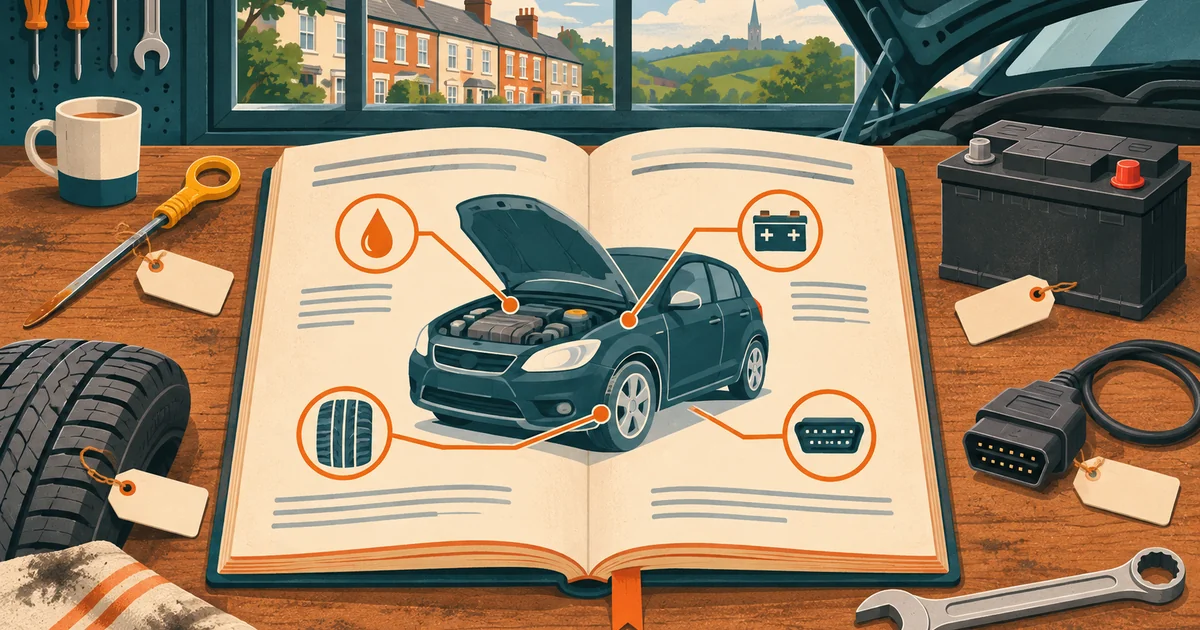
Short, plain-English definitions of the words you'll see on dashboards, MOT certificates, tool boxes and garage invoices. Each entry links to a fuller guide or answer on this site, and to the official or maker source where a fact isn't common knowledge. Your owner's handbook always has the final word for your car.
A
ABS
Anti-lock braking system: it stops the wheels locking under hard braking so you can keep steering. The RAC says that if the amber ABS light comes on by itself you should still have normal, unassisted braking, but take extra care and get it checked soon (RAC). See dashboard warning lights explained.
AdBlue
A diesel exhaust fluid used by many modern diesels to cut emissions, kept in its own tank and never added to the fuel. If it runs out, the car won't restart once switched off (AA). See what happens if AdBlue runs out.
Advisory
A note on an MOT result about an item that is wearing but not bad enough to fail. The DVSA manual says advisories inform the person who presented the vehicle (MOT inspection manual). See can I drive with an MOT advisory?.
AGM battery
Absorbent glass mat battery, a type of 12-volt battery often fitted to cars with stop-start or high electrical demand. The RAC puts AGM batteries at about £100 to £250 (checked 15 November 2026), and the AA says AGM and EFB batteries need a smart charger (RAC, AA). See how long does a car battery last?.
Axle stand
A lockable, height-adjustable stand that holds a raised car safely once it has been lifted with a jack. Never work under a car supported only by a jack (Haynes). See best trolley jack and axle stands UK.
C
CCA
Cold cranking amps: a battery rating for how much current it can deliver for 30 seconds at about -18°C while holding its voltage, which shows how well it starts an engine in the cold (Haynes). Match or exceed the figure your handbook specifies. See car battery: jump start and replace.
Consumer Rights Act 2015
The main UK law on consumer purchases. For services such as car repairs, it says the work must be done with reasonable care and skill, and gives you the right to have it redone at the trader's cost (s.49, s.55). See what are my rights if a garage repair goes wrong?.
Coolant
The liquid that carries heat away from the engine, usually a water and antifreeze mix. The RAC says to keep it between the min and max marks on the expansion tank (RAC), and the Highway Code warns to wait until an overheated engine cools before removing the cap. See check oil, coolant and screenwash.
D
Dangerous defect
The most serious MOT category: a "direct and immediate risk to road safety" or the environment (MOT inspection manual). The car fails, and GOV.UK says driving it can mean a fine of up to £2,500, a ban and 3 penalty points (GOV.UK). See can I drive my car if it fails its MOT?.
Dipstick
The long metal or plastic stick, usually with a coloured handle, used to check the engine oil level between its minimum and maximum marks. Some cars show the oil level electronically instead (AA). See check oil, coolant and screenwash.
DPF
Diesel particulate filter: it traps soot in a diesel's exhaust and burns it off from time to time. Lots of short, slow journeys can block it and bring on the DPF light (RAC). See what does the DPF light mean?.
DTC
Diagnostic trouble code: a five-character fault code, one letter (P, B, C or U) followed by four characters, such as P1234, stored by the car's on-board diagnostics and read with a scanner (RAC). A code points to an area to investigate rather than a guaranteed diagnosis. See best OBD2 scanner UK.
DVSA
The Driver and Vehicle Standards Agency, the government body that sets MOT standards and handles MOT appeals. GOV.UK says you can appeal a failed MOT to the DVSA within 14 working days (GOV.UK). See MOT defects, advisories and history.
E
ECU
Engine control unit: the computer that runs the engine. The AA explains that when a sensor reports a problem, the ECU turns on the engine management light (AA). See can I drive with the engine management light on?.
Engine management light
The engine-shaped warning light, sometimes called the check engine light. Steady amber is less urgent; red or flashing is serious (AA). See what does a flashing engine light mean?.
ESP
Electronic stability programme, also called ESC: it brakes individual wheels to help stop a skid. The RAC says a flashing ESP light means the system is working, while a light that stays on means it isn't working properly (RAC). See dashboard warning lights explained.
G
Glow plug
A heating element in a diesel engine that warms the cylinder so the engine starts easily. Its dashboard light should go out before you start; if it stays on or flashes, DENSO says a plug may have failed (DENSO). See what is the glow plug light?.
H
HID headlamp
High intensity discharge, often called xenon: a bright headlamp that uses an electric arc. What Car? says HID bulbs only suit cars that had them from new, and the DVSA's MOT manual notes they use high voltage (What Car?, MOT manual). See can I change a headlight bulb myself?.
High-voltage cable
The wiring that carries traction-battery power on hybrids and EVs, usually with orange insulation. The HSE says contact with parts live at over 110 volts DC can be fatal (HSE, MOT manual). Don't touch it. See is it safe to touch hybrid or EV cables?.
J
Jacking point
A reinforced spot where the car is designed to be lifted, usually marked by an arrow or pad; your handbook shows where (AA). Lifting elsewhere can damage the car or let it slip. See change a wheel safely.
Jump starter
A portable battery pack that can start a car with a flat battery without a second vehicle. The RAC describes jump starting with a portable battery pack as an alternative to jump leads (RAC). See best jump starter and battery charger UK.
L
Limp-home mode
A reduced-power mode the car switches to when it detects a serious fault, to protect the engine and let you get somewhere safe. The RAC mentions it for blocked DPFs and for running out of AdBlue (RAC on DPFs, RAC on AdBlue). See dashboard warning lights explained.
M
Major defect
An MOT defect that may affect the car's safety, have an impact on the environment or put other road users at risk. Any major defect means an MOT fail (MOT inspection manual). See MOT defects, advisories and history.
Minor defect
An MOT defect with no significant effect on safety or the environment. The car still passes, but the defect is listed and should be repaired (MOT inspection manual). See MOT defects, advisories and history.
MOT
The annual roadworthiness test for vehicles over three years old in Great Britain. GOV.UK sets the maximum fee for a car at £54.85 and says the test doesn't cover the condition of the engine, clutch or gearbox (GOV.UK). See MOT checklist.
MOT history
The free GOV.UK record of a vehicle's past MOT results, including passes, fails, mileage and defects, for car tests since 2005 (GOV.UK). You only need the number plate. See how do I check a car's MOT history?.
O
OBD2
On-board diagnostics, second generation; in Europe it's called EOBD. The RAC says all new petrol cars since 2001 and diesels since 2003 have it, with a socket you plug a scanner into to read fault codes (RAC). See best OBD2 scanner UK.
R
Regeneration
The process of burning off the soot stored in a diesel particulate filter. It can happen passively on long fast runs or actively, with the engine adding fuel to heat the exhaust (RAC). See what does the DPF light mean?.
S
Smart charger
A battery charger that adjusts its charge automatically and can maintain a battery over long periods without overcharging. The AA says EFB and AGM batteries need a smart charger (AA). See best jump starter and battery charger UK.
Space saver
A narrow, lightweight emergency spare wheel. The RAC says not to exceed 50mph on one and to use it only to get home or to a garage (RAC). See change a wheel safely.
SRS
Supplementary restraint system: the airbags and seatbelt pretensioners. The RAC says you shouldn't drive with the red airbag light on, as the airbags may not work in a crash (RAC). See red vs amber warning lights.
T
Torque wrench
A wrench that tightens nuts and bolts to a set force. The AA describes it as a tool to tighten wheel nuts to the exact specification in your owner's manual (AA). See best starter socket set UK.
TPMS
Tyre pressure monitoring system: it warns you when a tyre loses pressure. It's checked at the MOT on cars first used from 1 January 2012, and a malfunctioning system is a major defect (MOT inspection manual). See why is my tyre pressure light on?.
Tread depth
How deep the grooves in a tyre are. The legal minimum for cars is 1.6 mm across the central three-quarters of the tread and around the whole tyre (Highway Code); TyreSafe says experts commonly advise replacing at 3 mm (TyreSafe). See what is the legal tyre tread depth?.
Trolley jack
A wheeled hydraulic jack that lifts a car more easily and steadily than the jack supplied with it. Haynes says the supplied jack is fine for an emergency wheel change but shouldn't be trusted for working under the car (Haynes). Always add axle stands. See best trolley jack and axle stands UK.
V
V5C
The vehicle log book (registration certificate). GOV.UK says the 11-digit number from it lets you see where each MOT test was done in the MOT history service (GOV.UK). See how do I check a car's MOT history?.
Sources
- Getting an MOT — GOV.UK, accessed 15 November 2026.
- MOT inspection manual: introduction — DVSA on GOV.UK, accessed 15 November 2026.
- MOT inspection manual: 5. Axles, wheels, tyres and suspension — DVSA on GOV.UK, accessed 15 November 2026.
- MOT inspection manual: 4. Lamps, reflectors and electrical equipment — DVSA on GOV.UK, accessed 15 November 2026.
- The Highway Code: Annex 6 vehicle maintenance, safety and security — GOV.UK, accessed 15 November 2026.
- Check the MOT history of a vehicle — GOV.UK, accessed 15 November 2026.
- Consumer Rights Act 2015, section 49 — legislation.gov.uk, accessed 15 November 2026.
- Consumer Rights Act 2015, section 55 — legislation.gov.uk, accessed 15 November 2026.
- Problem with a car repair — Citizens Advice, accessed 15 November 2026.
- Electric and hybrid vehicles — Health and Safety Executive, accessed 15 November 2026.
- Dashboard warning lights guide: red, amber and green symbols explained — RAC, accessed 15 November 2026.
- Engine, DTC and OBD codes: how do I read them? — RAC, accessed 15 November 2026.
- Diesel particulate filters: guide to DPFs — RAC, accessed 15 November 2026.
- What is AdBlue? Why does your car need it? — RAC, accessed 15 November 2026.
- Car battery replacement and fitting — RAC, accessed 15 November 2026.
- How to check your coolant — RAC, accessed 15 November 2026.
- Space saver wheel guide: know before you buy — RAC, accessed 15 November 2026.
- How to jump start a car — RAC, accessed 15 November 2026.
- Dashboard warning lights and what they mean — The AA, accessed 15 November 2026.
- Engine management light: why is it on? — The AA, accessed 15 November 2026.
- What is AdBlue? AdBlue diesel exhaust fluid — The AA, accessed 15 November 2026.
- How to change a tyre — The AA, accessed 15 November 2026.
- What to do if your car has a flat battery — The AA, accessed 15 November 2026.
- How to check and top up your oil — The AA, accessed 15 November 2026.
- How to work under your car safely — Haynes, accessed 15 November 2026.
- Car battery amp hours and CCA: what do they mean? — Haynes, accessed 15 November 2026.
- Why might the glow plug warning light come on? — DENSO, accessed 15 November 2026.
- Tyre tread depth: legal limit and how to check — TyreSafe, accessed 15 November 2026.
- How to change a car headlight bulb: a step-by-step guide — What Car?, accessed 15 November 2026.