Guides · Safety
How to change a wheel safely: jacks, axle stands and when not to try
When it's safe to change a wheel and when to call for help, step-by-step jacking and wheel nut advice, axle stands, motorway rules and space-saver limits.
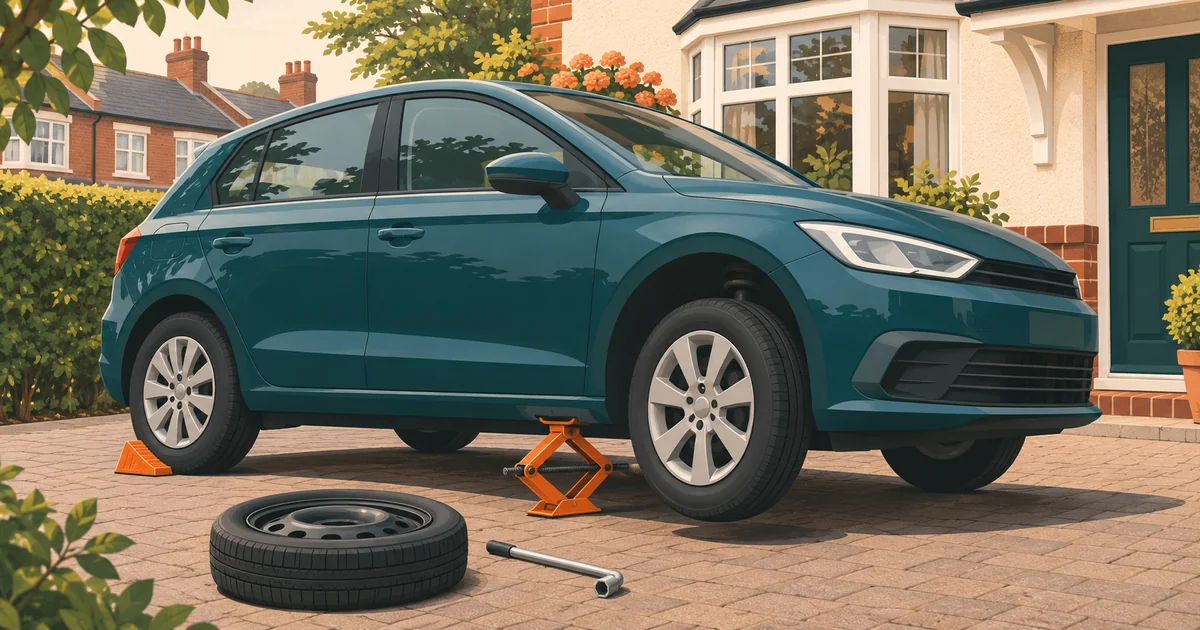
Changing a wheel is a useful skill. The wheel is the easy bit. The jack is the dangerous part, and so is where you've stopped. The AA says changing a wheel takes knowledge, practice and the right tools, and that you shouldn't expect to manage it alone the first time if you've never done it. So we start with when not to try, then go through the job step by step. Your owner's handbook shows your car's jacking points, wheel nut torque and spare wheel limits. Keep it to hand.
We haven't tested these products. This comparison is based on makers' published specifications and manuals, retailer listings and owner reviews (checked 15 November 2026).
First decide: should you be doing this at all?
The Highway Code says that if you have a flat tyre, stop as soon as it's safe. Only change the tyre if you can do so without putting yourself or others at risk. Otherwise call a breakdown service.
Call for help instead if:
- you're on a motorway, hard shoulder or emergency area (see below)
- you're on a busy road, a bend, a hill, soft ground or anywhere without room to work away from traffic
- it's dark or visibility is poor and you can't be clearly seen
- a wheel nut won't move, or the wheel won't come off the hub
- you don't have a working jack, wheel brace, locking wheel nut key, or a legal, inflated spare
The RAC says it's better to drive further and risk damaging the wheel rim than stop somewhere dangerous, but only as far as the nearest safe point.
Motorways: don't change a wheel
GOV.UK's Highway Code rules on breakdowns and incidents are clear:
- Rule 275: the safest place to stop is somewhere designed for parking. On motorways and other high-speed roads, that means a service area. Lay-bys, emergency areas and hard shoulders are other places of relative safety. But hard shoulders give less protection because they're so close to high-speed traffic.
- Rule 276: put a warning triangle at least 45 metres behind the car on the same side of the road, but never on motorways.
- Rule 277 (motorways): leave at the next exit or service area if you can. Otherwise move left, stop in an emergency area or on the hard shoulder, and get out on the side away from traffic. Then keep well away from the car and traffic, behind a safety barrier if there is one. It says do not attempt repairs on your vehicle and do not put a warning triangle on the carriageway. If you can't get out safely, stay in the car with your seat belt and hazard lights on and call 999.
Both the AA and the RAC say never try to change a tyre on a motorway or hard shoulder. On a smart motorway, the AA says to aim for the nearest emergency area and call for assistance.
Never get under a car on a jack
Safety first
Never put any part of your body under a car supported only by a jack. The roadside jack is for lifting the car just long enough to swap the wheel. The Health and Safety Executive's leaflet Working safely under motor vehicles being repaired says never work beneath a vehicle supported only on jacks. It says to use axle stands on a hard, level surface such as concrete, and to chock the wheels that stay on the ground. It includes accident reports of people killed when vehicles slipped off jacks. See can I work under a car on a jack?
At home, an axle stand placed under a strong point next to the jack adds a backup in case the jack fails. The AA lists one in its tyre-change kit. Use it only at a point your handbook approves. A pair of ratchet stands such as the Sealey VS2003 axle stands is about £44 at Amazon UK (checked 15 November 2026). The listing gives a 3-tonne rating per stand and a working height of 275–400 mm. If you do jobs at home beyond wheel changes, a low-entry trolley jack such as the Draper 02082 2-tonne trolley jack (about £55 at Amazon UK, checked 15 November 2026) is an option; its listing describes it as ideal for reduced-clearance cars. Our trolley jack and axle stand guide covers the options. Hybrid or EV owners should also stay clear of orange high-voltage cables when positioning a jack. The MOT inspection manual (section 20) says that's the colour of high-voltage insulation.
What you need
Pulled together from the AA and RAC kit lists:
- spare wheel with a legal, inflated tyre (or a space saver)
- the car's jack, ideally the one designed for your car
- wheel brace that fits your nuts or bolts, plus the locking wheel nut key if fitted
- wheel chocks (or bricks or wood blocks)
- owner's handbook, for jacking points, torque figure and spare pressure
- gloves, a torch, a reflective jacket and a warning triangle (not on motorways)
- a short plank to steady the jack on firm ground
- a torque wrench and tyre pressure gauge, if you have them
- an alignment tool, if your car uses wheel bolts and came with one
How to change a wheel, step by step
This follows the AA's 12-step guide and the RAC's 10 steps. If your handbook differs, follow the handbook.
- Park safely. Choose firm, level ground away from traffic, with room to work. Hazard lights on, handbrake on, first gear or Park, engine off. The RAC says get passengers out of the car and to a safe place.
- Chock the wheel diagonally opposite the flat one. For example, if the front left is flat, chock behind the rear right, as the RAC describes.
- Loosen the wheel nuts while the wheel is still on the ground. Remove any trim, use the locking key if needed, and turn anti-clockwise until each nut just gives. Don't remove them yet. The AA says position the brace so you push down, and don't stand on it or extend it.
- Find the jacking point nearest the flat wheel. It's shown in the handbook and usually marked by an arrow or reinforced pad. Sweep away stones and make sure the jack's base is on firm, level ground.
- Raise the car slowly until the flat tyre is clear of the ground. The RAC suggests 10–15 cm. Remember the inflated spare is bigger than the flat. Keep checking the jack stays upright. If it leans, lower it and start again.
- Remove the nuts and the wheel. Keep the nuts together on a clean surface, noting which way round they go. The AA says that if the wheel won't come off fairly easily, refit the nuts and call for help.
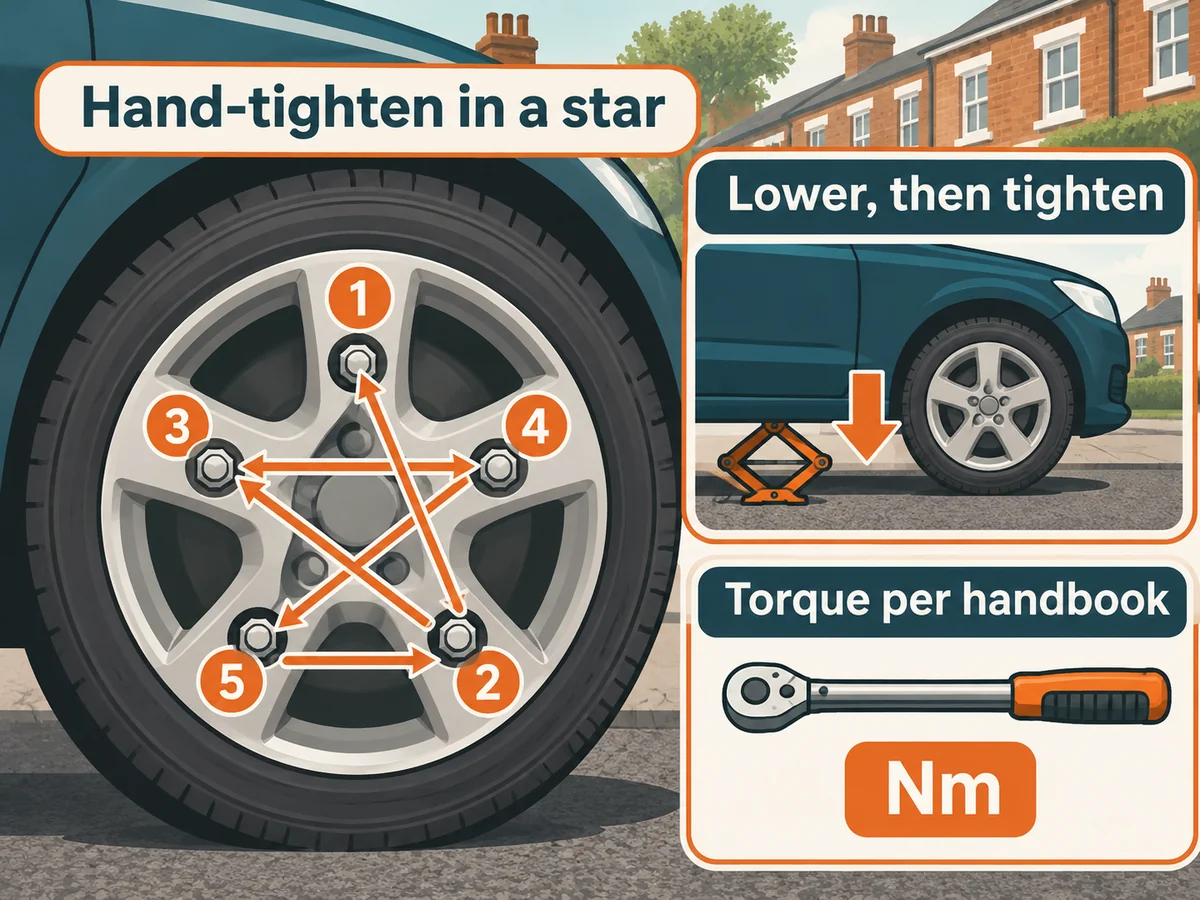
- Fit the spare. Line it up with the studs or bolt holes, using the alignment tool on bolted wheels. Hand-tighten the nuts in a diagonal pattern.
- Lower until the tyre touches the ground, then tighten the nuts firmly in a diagonal pattern. The AA says tighten securely but avoid over-tightening. Use a torque wrench set to the figure in your handbook if you have one.
- Lower fully and remove the jack. Give the nuts a final check for tightness, as the RAC suggests.
- Check the spare's pressure and adjust it to the handbook figure. Or drive carefully to the nearest forecourt.
- Stow the flat wheel and tools securely so nothing moves while you drive.
- Go to a garage or tyre fitter soon. The AA says have the punctured tyre repaired or replaced, the spare's pressure checked and the wheel nuts tightened properly.
Torque and re-checking the wheel nuts
Wheel nuts need to be tight, but the AA warns against over-tightening. It lists a torque wrench to tighten nuts "to an exact specification, as stated in your car owner's manual". A basic click-type wrench such as the Draper 30357 1/2-inch torque wrench is about £25 at Amazon UK (checked 15 November 2026). Its listing describes a 30–210 Nm range with Nm and lb scales, for clockwise tightening only. Check your handbook's figure is inside the range of any wrench you buy.
After a wheel change, have the nuts checked again, and torqued if you only used the wheel brace. The AA's final step is to get the wheel nuts tightened properly at a garage. If your handbook recommends re-checking the torque after a set distance, do that too.
Space savers and tyre repair kits
If your spare is a narrow space saver, the AA says it carries a speed restriction, usually 50 mph, shown on a sticker on the wheel and in the handbook. The RAC's space saver guide says never exceed that limit, because handling and grip are significantly affected. It also says a space saver is only meant to get you home or to a garage, not to be a permanent replacement. Many newer cars have a sealant and compressor kit instead of a spare. The RAC describes these as a temporary fix, so visit a garage as soon as possible to repair or replace the tyre. Keep your spare's pressure checked along with your other tyres. See our tyre tread and pressure guide.
FAQs
Can I change a wheel on the hard shoulder?
No. Highway Code rule 277 says not to attempt repairs on a motorway. Get well away from the car and traffic, behind the barrier if there is one, and call for help. The AA and RAC both say never change a tyre on a motorway or hard shoulder.
Can I use the car's jack to work underneath?
No. HSE guidance says never work beneath a vehicle supported only on jacks. Use axle stands on hard, level ground, with the other wheels chocked.
How fast can I drive on a space saver?
Check the sticker on the wheel and your handbook. The AA says the limit is usually 50 mph, and the RAC says never exceed it.
Sources
- How to change a tyre: simple guide with 12 easy steps — The AA, accessed 15 November 2026.
- How to change a tyre in 10 simple steps — RAC, accessed 15 November 2026.
- The Highway Code: Annex 6, vehicle maintenance, safety and security — Department for Transport, GOV.UK, accessed 15 November 2026.
- The Highway Code: breakdowns and incidents (rules 275 to 287) — Department for Transport, GOV.UK, accessed 15 November 2026.
- Working safely under motor vehicles being repaired (INDG434) — Health and Safety Executive, accessed 15 November 2026.
- Space saver wheel guide — RAC, accessed 15 November 2026.
- MOT inspection manual: introduction — DVSA, GOV.UK, accessed 15 November 2026.
- Amazon UK product listings for the axle stands, trolley jack and torque wrench named above, accessed 15 November 2026.