Guides · Tools and kit
Starter home garage tools: a buying checklist for DIY car maintenance
A practical checklist of the tools a UK home mechanic needs first, from axle stands and sockets to a tread gauge and battery tester, in a sensible buying order.

You don't need a pit and a ramp to look after your own car. A small, well-chosen kit lets you check tyres and batteries, read fault codes, change a wheel and do basic servicing safely. The trick is to buy in the right order: safety and checking tools first, then the tools for the jobs you actually plan to do, not the ones you might do one day. This checklist ties together our tool round-ups and adds three low-cost checking tools: a tread depth gauge and two battery testers.
We haven't tested these products. This comparison is based on makers' published specifications and manuals, retailer listings and owner reviews (checked 15 November 2026).
The checklist at a glance
| Priority | Tool | Why | Our guide or pick |
|---|---|---|---|
| 1 | Axle stands, chocks and a trolley jack | Safe lifting and support | Trolley jack and axle stands |
| 1 | Gloves and eye protection | Skin and eye safety | Any nitrile gloves and safety glasses |
| 2 | Tread depth gauge | Legal and safety check | Sealey VS0568, about £15 at Amazon UK, checked 15 November 2026 |
| 2 | Tyre inflator and pressure gauge | Weekly pressure checks | Tyre inflators |
| 2 | Battery tester | Check before you replace | MOTOPOWER voltmeter, about £19, or TOPDON BT50, about £41, at Amazon UK, checked 15 November 2026 |
| 3 | Socket set and torque wrench | Most fixings, wheel nuts | Starter socket sets |
| 3 | OBD2 code reader | Read engine-light codes | OBD2 scanners |
| 3 | Jump pack, leads or smart charger | Flat batteries | Jump starters and chargers |
| 4 | Torch or head torch, drip tray, funnel, rags | Everyday jobs | Basic items, no brand needed |
Before you buy: space and safety
Think about where you'll work. Axle stands need hard, level ground. HSE's leaflet Working safely under motor vehicles being repaired says use stands on a hard, level surface such as concrete, chock the wheels that stay on the ground, and never work beneath a vehicle supported only on jacks. A garage floor or a flat concrete drive is ideal; gravel and slopes are not.
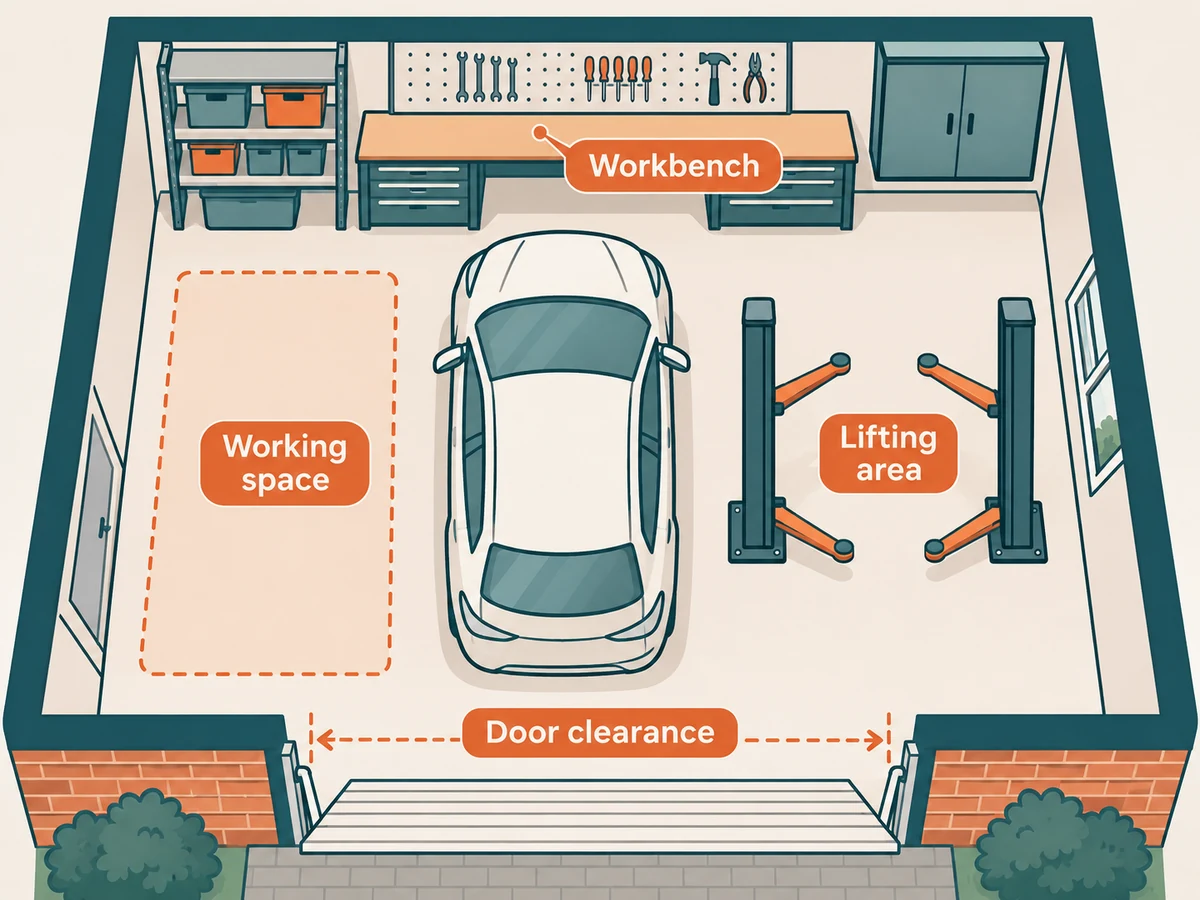
If you're setting up inside a garage, plan room for yourself, open drawers and the car door as well as the bench. Our sister site's guide to planning a workshop corner in a garage covers bench space, storage and leaving enough room to work around a parked car.
Safety first
Never put any part of your body under a car held up only by a jack. Lift with a jack, support on axle stands placed under the strong points in your handbook, on firm, level ground, with wheels chocked. On hybrids and EVs, never touch orange high-voltage cables; the MOT inspection manual introduction says high-voltage wiring insulation is orange.
Step 1: safety and lifting
Buy axle stands and wheel chocks at the same time as, or before, a trolley jack. The AA's tyre-change guide lists an axle stand as a secondary support in case the jack fails, plus chocks. Our trolley jack and axle stands guide compares low-entry and lightweight 2 tonne jacks and ratchet stands from 1.8 to 3 tonnes.
Add nitrile gloves and safety glasses. HSE's page on used engine oil warns that frequent and prolonged skin contact with used oil may cause dermatitis and other skin disorders, including skin cancer, and says nitrile gloves can reduce hand contamination. Don't keep oily rags in your pockets.
Step 2: checking tools
These are cheap, quick to use and tell you when something needs attention.
Tread depth gauge
The Highway Code annex 6 says cars must have at least 1.6 mm of tread across the central three-quarters of the tyre and around the entire circumference. A gauge takes the guesswork out.
Sealey VS0568 pocket tyre tread depth dial gauge
Suits: quick, regular tread checks on all four tyres and the spare.
Published specs: the listing describes a steel-bodied gauge with a 45 mm analogue dial reading 0–11 mm in 1 mm steps, colour-coded green (11–3 mm), yellow (2.99–1.6 mm, replacement advised) and red (1.59–0 mm, illegal), with a protective pouch.
Limits: 1 mm graduations mean you're reading between marks near the legal limit. Measure in several places across and around each tyre.
Tyre inflator and gauge
The Highway Code says check pressures weekly, when the tyres are cold. An inflator with auto-stop plus a separate pressure gauge makes that easy; see best tyre inflator UK.
Battery tester
The RAC's car battery page says a fully charged battery should read around 12.6 volts, and below 12.4 volts means it's weak. It gives an average battery replacement cost of £214 from RAC data, so testing before replacing is worthwhile.
MOTOPOWER 12V digital battery tester and charging system analyser
Suits: a simple voltage check on the battery and a rough check that the alternator is charging.
Published specs: the listing describes a 12 V tester with a four-digit lit display reading 4–20 V DC to about 0.01 V, coloured LEDs indicating battery and alternator status, and reverse-connection and over-voltage protection.
Limits: it reads voltage only. A battery can show a healthy voltage and still fail under load, so it won't tell you the battery's cranking ability.
TOPDON BT50 12V battery tester, 100–2,000 CCA
Suits: anyone who wants a health and cranking check before buying a new battery.
Published specs: the listing describes a conductance tester for 12 V lead-acid batteries with battery health, cranking and charging tests, a 100–2,000 CCA range, support for rating standards including CCA, EN, DIN, IEC, SAE and JIS, and a data review function for earlier results.
Limits: for 12 V lead-acid batteries only, according to the listing. You need the battery's rating from its label to get a meaningful result.
Step 3: tools for jobs
- Socket set and torque wrench. A 1/4-inch and 1/2-inch metric set covers most jobs, and a 1/2-inch torque wrench lets you tighten wheel nuts to the handbook figure. See best starter socket set.
- OBD2 code reader. Reads the fault code behind an engine light. It points you in a direction but doesn't diagnose or fix; clearing a code doesn't cure the fault. See best OBD2 scanner and our warning-light lookup tool.
- Jump pack, leads or smart charger. A pack in the boot for emergencies, a smart charger at home for maintenance. See best jump starter and battery charger.
Step 4: the small stuff
A torch or head torch, a drip tray, a funnel, clean rags, a wire brush and a notebook for torque figures and part numbers all earn their place. Keep your owner's handbook with the kit. It's where you'll find jacking points, tyre pressures, fluid specifications and torque figures.
Know when to stop
A home kit is perfect for checks, wheels, bulbs, wipers, batteries and simple servicing. Brakes, steering, suspension, airbags and anything on a hybrid's high-voltage system are best left to a qualified mechanic unless you have the training and the maker's procedure. If an MOT is coming up, our MOT checklist shows which simple checks you can do at home first.
FAQ
What should I buy first for a home garage?
Start with safety and checking tools: axle stands and chocks (before or with a jack), gloves and eye protection, a tread depth gauge and a tyre pressure gauge or inflator. Then add a socket set and the tools for jobs you plan to do.
Is a voltmeter battery tester good enough?
For a quick check, yes. The RAC says around 12.6 V means fully charged and below 12.4 V means weak. A conductance tester like the BT50 adds a cranking and health check, which voltage alone can't show.
Do I need a big workshop?
No. You need firm, level ground for lifting, enough room to work around the car, and somewhere dry to keep tools. A corner of a garage is plenty for most home jobs.
Sources
- Working safely under motor vehicles being repaired (INDG434) — Health and Safety Executive, accessed 15 November 2026.
- Used engine oil — Health and Safety Executive, accessed 15 November 2026.
- The Highway Code: annex 6, vehicle maintenance, safety and security — GOV.UK, accessed 15 November 2026.
- Car battery — RAC, accessed 15 November 2026.
- How to change a tyre — The AA, accessed 15 November 2026.
- MOT inspection manual: introduction — GOV.UK (DVSA), accessed 15 November 2026.
- Amazon UK product listings for the tread gauge and battery testers named above (linked in each product box), accessed 15 November 2026.