Guides · Tools and kit
Best starter socket set UK: drive sizes, metric sockets and a torque wrench
Starter metric socket sets compared by drive size and contents, plus a 1/2 inch torque wrench for wheel nuts, with how to choose and look after them.
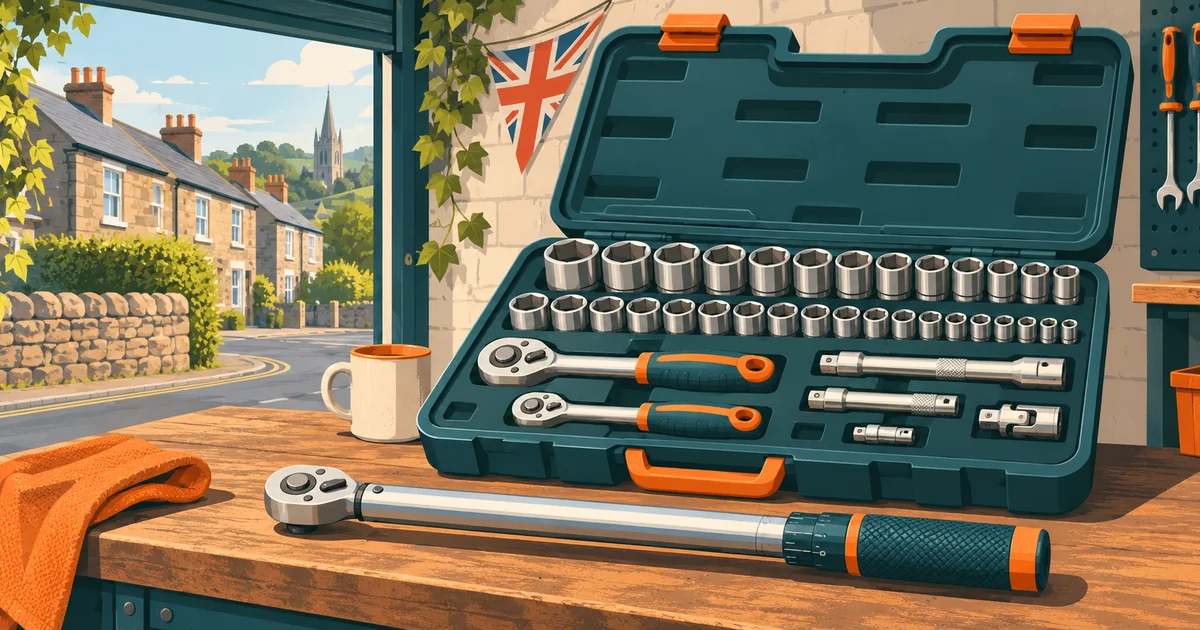
Every home garage starts with a socket set. With a ratchet, a few extensions and the right metric sockets you can tackle battery terminals, number plate screws, wheel nuts and plenty more. Add a torque wrench and you can tighten wheel nuts and other fixings to the figure in your handbook, not by feel. Here we explain drive sizes, compare three starter sets on sale in the UK, and cover one 1/2-inch torque wrench.
We haven't tested these products. This comparison is based on makers' published specifications and manuals, retailer listings and owner reviews (checked 15 November 2026).
Quick comparison
| Product | Type | Key published spec | Price seen at Amazon UK |
|---|---|---|---|
| Draper 12-piece 1/2" set | 1/2" drive socket and ratchet set | 10 sockets, 10–24 mm; ratchet; extension | about £27, checked 15 November 2026 |
| WORKPRO 108-piece set | 1/4" and 1/2" drive set with bits | Metric sockets 4–32 mm across both drives; two 72-tooth ratchets | about £45, checked 15 November 2026 |
| Draper 83-piece HI-TORQ set | 1/4" and 1/2" drive set with extras | 28 standard sockets, 4–32 mm; pliers, spanners, bits; lifetime warranty | about £66, checked 15 November 2026 |
| Draper 30357 torque wrench | 1/2" drive click-type torque wrench | 30–210 Nm; ratchet head; Nm and lb scales | about £25, checked 15 November 2026 |
Drive sizes explained
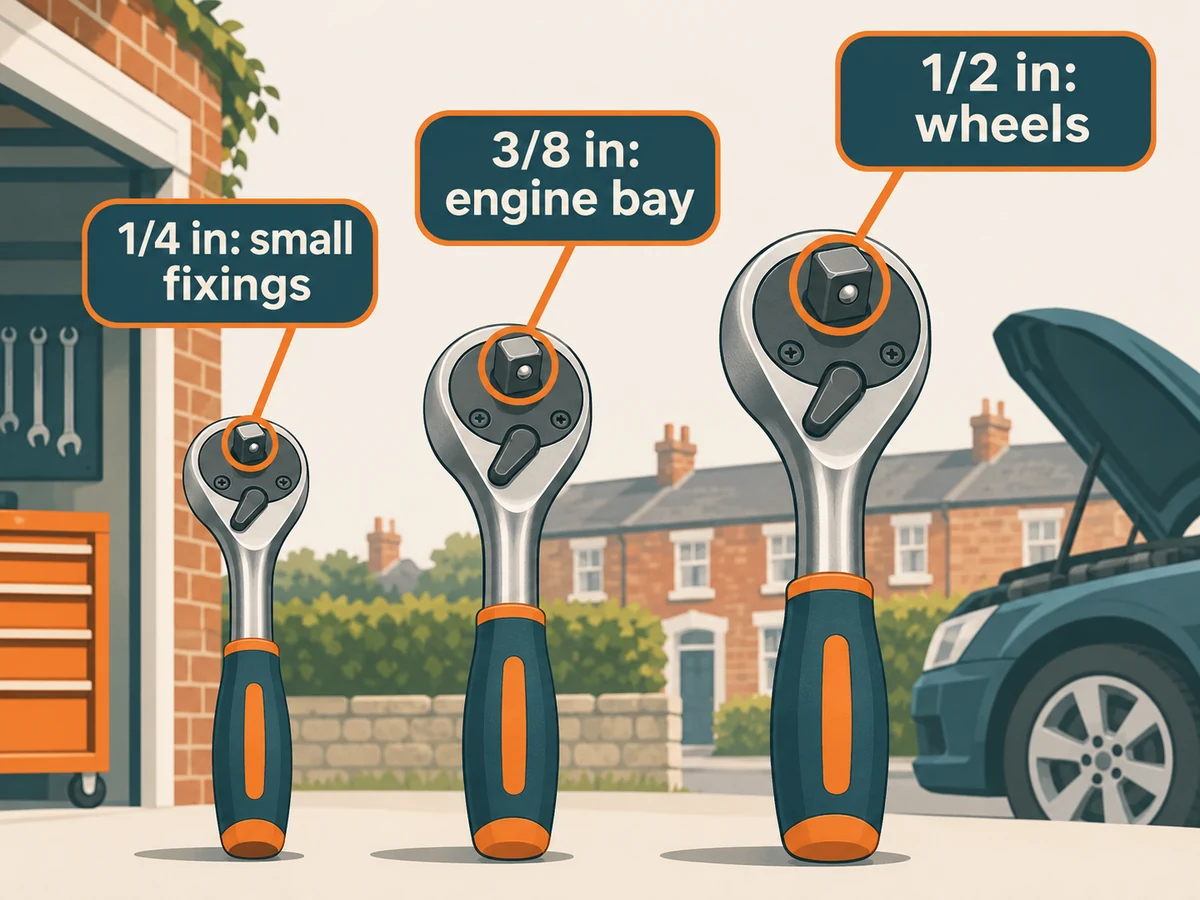
The "drive" is the size of the square peg on the ratchet that the socket clips onto. It isn't the size of the nut.
- 1/4-inch drive is small and light, for little fasteners in tight spaces: trim screws, sensor bolts, small clips and brackets. Sockets usually run from around 4 mm to 14 mm.
- 3/8-inch drive is the middle size, popular for general engine-bay work. None of the sets below includes a 3/8-inch ratchet, though some include adaptors.
- 1/2-inch drive is the heavy-duty size for larger fasteners such as wheel nuts and suspension bolts. Torque wrenches for wheel nuts are usually 1/2-inch drive.
A starter kit with 1/4-inch and 1/2-inch covers most jobs. You can add a 3/8-inch set later if you find you need it.
Metric sizes
Modern cars use metric fasteners, so buy metric sockets (in millimetres). Check you have the common sizes you'll meet, and if your car has locking wheel nuts, keep the key with your kit; the RAC's tyre-change guide lists it among the essentials.
Six-point or twelve-point? Six-point sockets grip the flats of a nut and are less likely to round it off, which matters on rusty or tight fixings. Draper says its HI-TORQ sockets grip the flat surfaces rather than the corners of a fixing for exactly this reason.
The socket sets
Draper 12-piece 1/2" square drive metric socket and ratchet set
Suits: a first set for wheels and larger fixings, or a 1/2-inch top-up to an existing small set.
Published specs: the listing gives ten 1/2-inch drive sockets (10, 13, 14, 15, 16, 17, 18, 19, 21 and 24 mm), a 72-tooth reversible ratchet with soft grip and quick-release button, and an extension bar, all chrome vanadium steel, hardened and tempered with a satin finish, on a plastic hanging rack.
Limits: 1/2-inch only, so there are no small sockets for fiddly jobs, and no case.
WORKPRO 108-piece socket set, 1/4" and 1/2" drive
Suits: a do-everything starter set on a budget, including screwdriver bits for trim and interior jobs.
Published specs: the listing describes chrome vanadium sockets in both drive sizes (1/4-inch sockets from 4 to 14 mm plus deep sockets; 1/2-inch sockets from 10 to 32 mm plus deep sockets), E-Torx sockets, 16 mm and 21 mm spark plug sockets, screwdriver bits, extension bars, a sliding handle, and 1/4-inch and 1/2-inch 72-tooth quick-release ratchets, in a 37 x 8 x 28 cm case.
Limits: lots of pieces in a compact case; check the specific sizes you need are included before buying.
Draper 83-piece HI-TORQ socket set, 1/4" and 1/2" drive
Suits: someone who wants a set to last, with a few hand tools included.
Published specs: the listing describes 12 standard 1/4-inch sockets (4–13 mm), 5 deep 1/4-inch sockets (6–10 mm), 16 standard 1/2-inch sockets (10–32 mm) and three 1/2-inch impact sockets, all six-point HI-TORQ. It also includes 72-tooth quick-release ratchets in both drives, extensions, universal joints, a sliding T-bar, a spark plug socket, six combination spanners, screwdriver bits, mini pliers, a flexible screwdriver and an LED pick-up tool, in a plastic case, with Draper's lifetime warranty.
Limits: the dearest set here. As with the others, there's no 3/8-inch ratchet.
The torque wrench
Draper 30357 1/2" square drive ratchet torque wrench, 30–210 Nm
Suits: tightening wheel nuts and other larger fixings to the figure in your handbook.
Published specs: the listing describes a 1/2-inch drive ratchet head, Nm and lb scales on the barrel, a micrometer-type adjusting sleeve for presetting the torque, and a blow-moulded storage case. The listing says it's designed for tightening clockwise, right-hand threads only. A user guide is linked from the listing.
Limits: 30 Nm is its lowest setting, so it isn't suitable for small, low-torque fixings. It's a tightening tool, not a breaker bar.
How to choose
- Start with 1/2-inch and 1/4-inch. That covers wheel nuts and most small fixings.
- Check the sizes, not the piece count. A big piece count often includes lots of bits. Make sure the sockets you're likely to need are there.
- Prefer six-point sockets for stubborn fasteners.
- A case matters. Loose sockets go missing; a fitted case shows at a glance what's out.
- Buy a torque wrench whose range covers your job. Find your wheel nut torque in the handbook and check it falls comfortably inside the wrench's range.
Using and looking after a torque wrench
The AA's tyre-change guide describes a torque wrench as a tool that helps you tighten wheel nuts to the exact figure stated in your owner's manual. It says to hand-tighten wheel nuts in a diagonal pattern, lower the car so the tyre is in firm contact with the ground, then tighten further, securely but without over-tightening. After using a spare, the AA advises having a garage check the wheel nuts are tightened properly.
Look after the wrench as its maker says. Draper's listing states the 30357 is for clockwise right-hand threads only, so don't use it to undo nuts; use a breaker bar or ratchet instead. Read the supplied instructions for storage, setting and calibration advice, keep it in its case, and don't drop it. If it has been dropped or misused, consider having it checked before you rely on it again.
Safety
- Never get under a car supported only by a jack. HSE's leaflet Working safely under motor vehicles being repaired says use axle stands, on a hard, level surface, with wheels chocked. See our guide to trolley jacks and axle stands.
- Wear eye protection when loosening rusty fasteners, and pull a ratchet towards you rather than pushing, so your knuckles don't hit anything if it slips.
- Disconnect the battery as your handbook directs before working near electrics. On hybrids and EVs, the MOT inspection manual introduction says high-voltage wiring has orange insulation: never touch it.
- If a fixing is safety-critical (brakes, steering, suspension) and you're unsure of the torque or procedure, leave it to a qualified mechanic.
FAQ
What drive size do I need for wheel nuts?
1/2-inch drive is the usual choice for wheel nuts, and torque wrenches for wheels are generally 1/2-inch. Check the socket size for your wheel nuts and the torque figure in your handbook.
Do I need a torque wrench?
For wheel nuts and anything safety-related, it's the best way to hit the figure in your handbook. The AA describes it as a tool for tightening wheel nuts to the exact specification in the owner's manual.
Can I use a torque wrench to undo wheel nuts?
Not this one. Draper says the 30357 is designed for tightening clockwise right-hand threads only. Use a breaker bar or wheel brace to loosen.
Sources
- How to change a tyre — The AA, accessed 15 November 2026.
- How to change a tyre in 10 simple steps — RAC, accessed 15 November 2026.
- Working safely under motor vehicles being repaired (INDG434) — Health and Safety Executive, accessed 15 November 2026.
- MOT inspection manual: introduction — GOV.UK (DVSA), accessed 15 November 2026.
- Amazon UK product listings for each set and the torque wrench named above (linked in each product box), accessed 15 November 2026.