Guides · Tools and kit
Best trolley jack and axle stands UK: how to choose and use them safely
Low-entry and lightweight 2 tonne trolley jacks and ratchet axle stands compared by capacity and lift height, with the safety rules for working under a car.
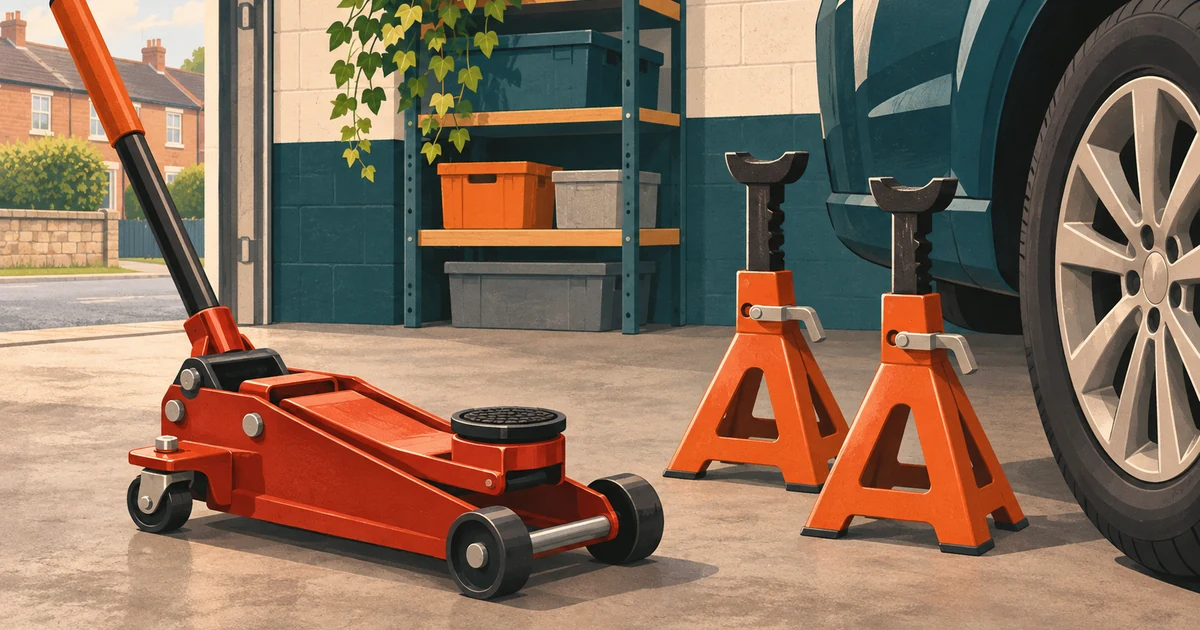
A trolley jack lifts the car. Axle stands hold it up. You need both, every time, because a jack is a lifting tool and can lower or slip without warning. Below we compare three 2 tonne trolley jacks and three pairs of axle stands on sale in the UK, explain how to choose by capacity, lift range and entry height, and set out the safety rules. Those matter far more than the brand on the side.
We haven't tested these products. This comparison is based on makers' published specifications and manuals, retailer listings and owner reviews (checked 15 November 2026).
Safety first
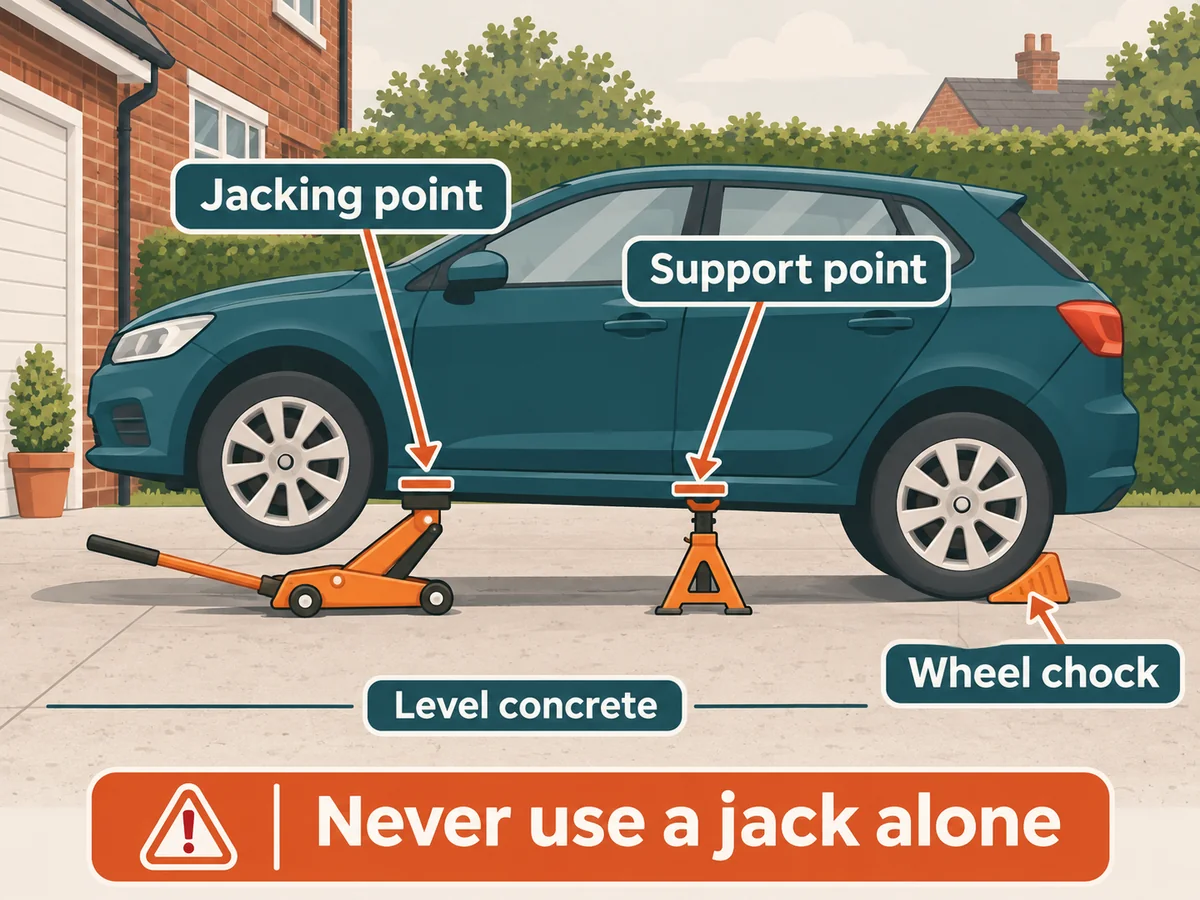
Never put any part of your body under a car held up only by a jack. Lift with the jack, lower the car onto axle stands placed under the strong points shown in your handbook, on firm level ground, with the wheels still on the ground chocked. HSE accident reports include people killed when cars slipped off jacks with axle stands available but unused.
Quick comparison
| Product | Type | Key published spec | Price seen at Amazon UK |
|---|---|---|---|
| Draper 02082 | Low-entry trolley jack | 2 tonne; 85–380 mm lift | about £55, checked 15 November 2026 |
| Sealey 1050CXLE | Low-entry trolley jack | 2 tonne; 90 mm minimum height | about £57, checked 15 November 2026 |
| Hilka 82820012 | Lightweight trolley jack | 2 tonne; 135–330 mm lift | about £40, checked 15 November 2026 |
| Sealey VS2003 | Ratchet axle stands, pair | 3 tonnes each; 275–400 mm | about £44, checked 15 November 2026 |
| Draper 30878 | Ratchet axle stands, pair | 2 tonnes each; 277–435 mm | about £31, checked 15 November 2026 |
| Amazon Basics steel stands | Ratchet axle stands, pair | 1.8 tonnes listed; 265–402 mm | about £19, checked 15 November 2026 |
The safety rules first
HSE's leaflet Working safely under motor vehicles being repaired (INDG434) is written for garages, but its rules apply just as much on a driveway. It says:
- Never work beneath a vehicle supported only on jacks; use axle stands in good condition.
- Use stands on a hard, level surface such as concrete.
- Securely chock the wheels that stay on the ground.
- Put each stand under a strong point on the vehicle, and consult the manufacturer's handbook for where those are.
- Don't exceed the rated capacity of the stand, and use close-fitting pins of the right specification, never a screwdriver or bolt as a substitute.
- Make sure the ground is firm and level before raising a vehicle.
HSE's page on struck-by accidents says these cause about 20% of injuries in motor vehicle repair, including vehicles falling off lifts and vehicles moving while being worked on. Handbrake on, car in gear or park, and nobody starting the engine from outside the car.
The AA's guide to changing a tyre lists an axle stand as "a secondary support in case the jack fails", and wheel chocks in the kit. It says jacking points are usually marked with an arrow or reinforcing pad and that you should move the car if the ground under the jack isn't level. The RAC's tyre-change guide explains where to chock: on the wheel diagonally opposite the one being lifted.
Garage tip
Jacking points and axle stand points are not always the same place. Many handbooks show separate positions for a trolley jack and for stands, and some cars need a rubber pad or adaptor to avoid crushing the sill. Check your handbook before you lift. If it doesn't show stand positions, ask a dealer or garage.
Choosing a trolley jack
Capacity. All three jacks here are rated at 2 tonnes. A trolley jack only lifts one corner or one end at a time, but choose a rating with a comfortable margin over the weight you're lifting, and check your car's weight in the handbook. Heavier SUVs and vans may need a higher-rated jack.
Minimum height (low entry). This is how low the saddle sits when fully lowered. Lowered cars, sports cars and cars on a flat tyre may leave less than 100 mm under the jacking point. The Draper and Sealey low-entry models are listed at 85 mm and 90 mm.
Maximum height. It needs to lift high enough to fit axle stands underneath at a useful height. The Hilka's 330 mm top is lower than the Draper's 380 mm, which matters on taller cars.
Chassis length and weight. Short-chassis jacks are easier to store and carry but have less reach under the car. A 13 kg jack is portable; a long workshop jack is not.
Standards and safety valves. Look for an overload valve and a stated standard. Draper's maker page says the 02082 is made to the EN1494 specification.
The trolley jacks
Draper 02082 low-entry trolley jack, 2 tonne
Suits: most hatchbacks and saloons, including lower cars, in a home garage.
Published specs: Draper's product page lists 2 tonne capacity, 85 mm minimum and 380 mm maximum height, 560 mm chassis, 47 mm saddle, 500 mm handle and 13 kg weight. It has an overload safety valve, rear swivelling steel castors and a carry handle, and is made to EN1494, with a 12-month warranty.
Limits: short chassis means less reach under the car; 2 tonnes is not for heavy vans.
Sealey 1050CXLE low-entry trolley jack, 2 tonne
Suits: low or lowered cars where clearance under the jacking point is tight.
Published specs: the listing describes a steel chassis with welded castor supports, a one-piece hydraulic unit, an overload valve, a finger guard and a one-piece pumping handle. It gives a minimum height of 90 mm and a one-year guarantee.
Limits: the listing we checked didn't state maximum lift height, so check the Sealey instructions or ask the seller before buying for a taller car.
Hilka 82820012 lightweight trolley jack, 2 tonne
Suits: occasional use on small cars, and drivers who want something light to carry.
Published specs: the listing describes an all-steel, compact unit with swivel castors and a lifting range of 135 mm to 330 mm.
Limits: the 135 mm minimum may not fit under a low car or one with a flat tyre, and the 330 mm maximum leaves less room for stands on taller cars.
Choosing axle stands
Buy stands in pairs and use one pair at a time; HSE says that for most axle stands you should use no more than a single pair. Check:
- Capacity per stand and per pair. Listings often quote both. Work from the lower figure and stay well within it.
- Height range. The stand's minimum height has to fit under the raised car, and its maximum should give you room to work.
- Locking. Ratchet stands lock with teeth; HSE warns pins must be close-fitting and of the correct specification.
- Base and condition. A wide base is more stable. Never use a bent, cracked or rusty stand, and inspect stands before each use.
The axle stands
Sealey VS2003 axle stands, 3 tonne, pair
Suits: anyone wanting a generous capacity margin on a family car.
Published specs: the listing gives 3 tonnes per stand (6 tonnes per pair), a working height of 275 mm to 400 mm, a cast iron ratchet post and a welded steel plate base. It says angled teeth lock the post more tightly the more weight is applied.
Limits: 400 mm maximum height is fine for most cars but may be low for working comfortably under an SUV.
Draper 30878 ratcheting axle stands, 2 tonne, pair
Suits: hatchbacks and saloons where a little more height helps.
Published specs: the listing gives 2,000 kg per stand (4,000 kg per pair), 277 mm minimum and 435 mm maximum height, and a 36 x 85 mm saddle.
Limits: a lower per-stand rating than the Sealey; check it against your car.
Amazon Basics steel jack stands, pair
Suits: small, light cars on a tight budget.
Published specs: the listing describes a pair rated at 2 US tons (1.8 metric tonnes, about 1,814 kg), with 265 mm minimum and 402 mm maximum height, a self-locking ratchet and a rust-resistant coated steel frame, to be used on flat ground.
Limits: the lowest capacity here, and the listing doesn't spell out whether the figure is per stand or per pair. Treat it as the pair rating and check it against your car's weight before relying on it.
Step by step: lifting onto stands
- Park on firm, level concrete. Handbrake on, in gear or park, engine off.
- Chock the wheel diagonally opposite the corner you're lifting.
- Find the trolley jack point in your handbook. Position the saddle squarely.
- Lift slowly, watching that the car and jack stay straight.
- Set the stand height, place the stand under the handbook's support point, and lower the car gently onto it.
- Check the car sits squarely and steadily on the stands before going near it. If anything looks off-centre or moves, lift again and reset.
- Follow your jack and stand instructions on whether to leave the jack in place as a back-up, but never rely on it.
To lower, lift slightly off the stands, remove them, then lower slowly with everyone clear. If you're not confident, a garage with a proper lift is the safer choice. See our guide to changing a wheel safely and the short answer to can I work under a car on a jack?
FAQ
Can I use the jack that came with my car to work underneath it?
No. The jack in the boot is for changing a wheel at the roadside. HSE says never work beneath a vehicle supported only on jacks. Use axle stands under the handbook's support points.
What capacity axle stands do I need?
Check your car's weight in the handbook and choose stands rated comfortably above the load they'll carry. Don't exceed the rated capacity, as HSE advises, and use the lower of the per-stand and per-pair figures.
Can I use axle stands on gravel or tarmac?
HSE says use stands on a hard, level surface such as concrete. Gravel, soft tarmac on a hot day, and slopes are unsafe.
Do I still need chocks if I'm using axle stands?
Yes. HSE says to chock wheels remaining on the ground, and the AA and RAC include chocks in their tyre-change kit lists.
Sources
- Working safely under motor vehicles being repaired (INDG434) — Health and Safety Executive, accessed 15 November 2026.
- INDG434 publication page — Health and Safety Executive, accessed 15 November 2026.
- Struck by accidents — Health and Safety Executive, accessed 15 November 2026.
- How to change a tyre — The AA, accessed 15 November 2026.
- How to change a tyre in 10 simple steps — RAC, accessed 15 November 2026.
- Low Entry Trolley Jack, 2 Tonne (02082) — Draper Tools, accessed 15 November 2026.
- Amazon UK product listings for each jack and stand named above (linked in each product box), accessed 15 November 2026.