Free tool
Warning light lookup
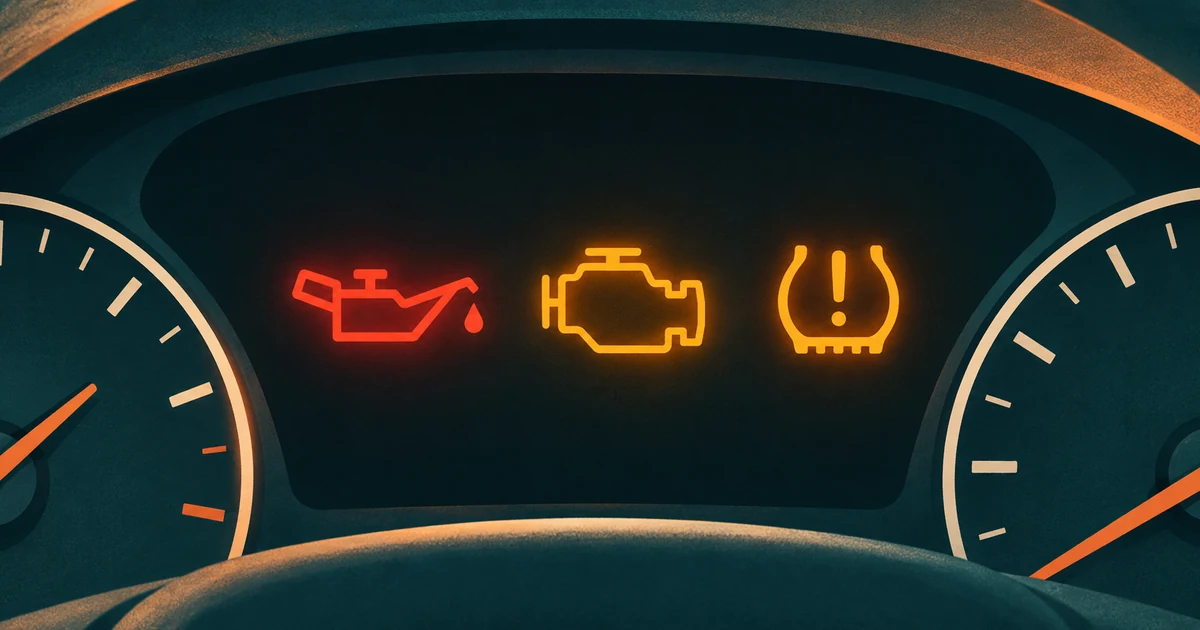
Something just lit up on the dashboard. Don't panic, and don't ignore it either. Find the light by colour or by a word in its name or symbol, and see what it usually means, how urgent it is, what to check and when to stop driving.
Indicative only. Symbols, colours and advice vary by maker and model. Your owner's handbook is the authority for your car. If a red light comes on while you are driving, stop when it is safe and legal to do so. If in doubt, call your breakdown provider or a qualified mechanic. This page is general guidance, not a diagnosis.
How it works
Every warning light below is listed on this page, so it works without JavaScript: scroll down or use your browser's find-in-page. The stripe down the side of each card shows the colour of the light. The solid badge shows how urgent it is: red for stop when safe, amber for get it checked soon, green for usually information. Go by the badge. A flashing amber engine light, for one, still means stop. With JavaScript on, the filter narrows the list as you type. Each line of advice comes from the AA, the RAC or the Highway Code, all opened on 15 November 2026. Where they disagree, both views are shown. The general rule, from the AA and RAC: red means stop when safe, amber means get it checked soon, green, blue or white means a system is on or working. The Highway Code says warning lights should go out once the engine starts (except the handbrake light), and if one stays on or comes on while driving, stop and investigate.
Oil pressure warning light
- Usual symbol
- An old-style oil can, sometimes with a drip
- What it means
- The AA says it shows when there is no oil pressure in the engine. The RAC says it can mean the oil level or pressure is too low or the oil temperature is too high.
- What to check
- Once stopped with the engine off, look for obvious leaks and check the oil level on the dipstick, topping up as your handbook describes.
- When to stop driving
- Now. Both the AA and RAC say stop as soon as it is safe. If the level is correct and the light stays on, do not drive on: the AA and RAC point to an oil supply problem such as the oil pump and say call for help.
- Sources (checked 15 November 2026)
- The AA, Dashboard warning lights and what they mean; RAC Drive, Dashboard warning lights guide
Battery or charging warning light
- Usual symbol
- A rectangle battery with + and - marks
- What it means
- The battery may not be charging. The AA lists wiring, the alternator or its drive belt, or simply a flat battery. The Highway Code says the charge light may mean the battery isn't charging and should be checked as soon as possible.
- What to check
- Note whether lights or electrics are dimming. Do not keep restarting the engine.
- When to stop driving
- The AA says stop in a safe place, turn off the engine and call for help, and not to restart it. The RAC says you should not drive with this light on because of the risk of sudden power failure.
- Sources (checked 15 November 2026)
- The AA, Dashboard warning lights and what they mean; RAC Drive, Dashboard warning lights guide; GOV.UK, The Highway Code, Annex 6: vehicle maintenance, safety and security
Brake system warning light
- Usual symbol
- An exclamation mark inside a circle with curved brackets either side (sometimes the letter P or the word BRAKE)
- What it means
- A problem with the braking system, or the parking brake still on. The AA and RAC mention low brake fluid, a sensor fault or worn pads.
- What to check
- First make sure the handbrake or electronic parking brake is fully released. If the light stays on, stop and check the brake fluid level against the marks on the reservoir.
- When to stop driving
- The RAC says do not drive with a red brake light: pull over when safe, keep speed low and avoid braking suddenly. The AA says if the pedal goes further than usual the hydraulic circuits may have failed, so pull over and get help. If the fluid level is fine it may be a sensor fault, which the AA says is safe to drive to a garage.
- Sources (checked 15 November 2026)
- The AA, Dashboard warning lights and what they mean; RAC Drive, Dashboard warning lights guide; GOV.UK, The Highway Code, Annex 6: vehicle maintenance, safety and security
Brake and ABS lights on together
- Usual symbol
- The red brake symbol and the amber ABS symbol lit at the same time
- What it means
- The AA says there could be a major fault with the brakes. The RAC says the braking system may have malfunctioned and the brakes may not work properly.
- What to check
- Do not try to diagnose it at the roadside.
- When to stop driving
- Now. Slow down gradually, avoid sudden braking, stop when safe and call for recovery. The AA says do not drive the car until it has been fixed.
- Sources (checked 15 November 2026)
- The AA, Dashboard warning lights and what they mean; RAC Drive, Dashboard warning lights guide
Engine (coolant) temperature warning light
- Usual symbol
- A thermometer standing in wavy lines of liquid
- What it means
- The engine is overheating. The RAC lists low coolant, perhaps from a leak, or something bigger such as head gasket failure.
- What to check
- Wait until the engine has cooled naturally before opening the coolant cap (Highway Code), then check the level against the marks on the expansion tank and top up as the handbook says.
- When to stop driving
- Now. The RAC says stop straight away. If the light comes back after topping up, get it checked; the RAC suggests calling for recovery rather than risking it.
- Sources (checked 15 November 2026)
- RAC Drive, Dashboard warning lights guide; The AA, Dashboard warning lights and what they mean; GOV.UK, The Highway Code, Annex 6: vehicle maintenance, safety and security
Airbag (SRS) warning light
- Usual symbol
- A seated person with a large circle (the airbag) in front
- What it means
- Part of the airbag or seat-belt pretensioner system is not working correctly, according to the RAC. The AA mentions damaged wiring under a seat or a fault with the airbag itself.
- What to check
- Nothing to check yourself. Airbag systems are a job for a garage.
- When to stop driving
- The RAC says you should not drive with the red airbag light on because the airbag may not go off in a crash, or could deploy unexpectedly. The AA says get it checked at a garage as soon as possible.
- Sources (checked 15 November 2026)
- RAC Drive, Dashboard warning lights guide; The AA, Dashboard warning lights and what they mean
Power steering warning light
- Usual symbol
- A steering wheel, often with an exclamation mark
- What it means
- A fault with the power steering. On hydraulic systems the AA says the usual cause is low fluid from a leak. On electric systems the RAC says a restart can sometimes clear it.
- What to check
- When safely stopped, the RAC suggests switching off, waiting 30 seconds and restarting. If the light stays on, get it checked.
- When to stop driving
- The RAC says it is not advisable to drive with the red power steering light on, as steering becomes heavy. The AA says drive carefully to the nearest garage. If steering is heavy, stop.
- Sources (checked 15 November 2026)
- RAC Drive, Dashboard warning lights guide; The AA, Dashboard warning lights and what they mean
Engine management light, flashing
- Usual symbol
- An engine outline, sometimes with the word CHECK, flashing
- What it means
- A more serious engine fault. The AA warns of damage to the catalytic converter or diesel particulate filter.
- What to check
- Avoid heavy acceleration and high engine speed.
- When to stop driving
- The AA says it is not safe to drive while it is flashing: stop when safe, restart after 2 minutes, and if it is still flashing turn off and call for help.
- Sources (checked 15 November 2026)
- The AA, Dashboard warning lights and what they mean
Engine management light, steady
- Usual symbol
- An engine outline, sometimes with the word CHECK
- What it means
- A sensor has reported a problem to the engine control unit. Causes range from a loose sensor or wire to emissions system or catalytic converter faults, according to the RAC and AA.
- What to check
- Note any loss of power, stuttering or other lights. A garage diagnostic (or an OBD2 code reader) reads the stored fault code.
- When to stop driving
- Advice differs. The AA says it is OK to drive if it is always lit and there is no loss of power, but get it checked soon. The RAC's FAQ says you should not continue to drive and should contact a garage. If there is loss of power or another light, stop.
- Sources (checked 15 November 2026)
- The AA, Dashboard warning lights and what they mean; RAC Drive, Dashboard warning lights guide
ABS (anti-lock brakes) warning light
- Usual symbol
- The letters ABS inside a circle with curved brackets
- What it means
- A fault with the anti-lock braking system, often a sensor, according to the AA.
- What to check
- Listen for noises from the wheels. Check whether the red brake light is also on (if so, see 'Brake and ABS lights on together').
- When to stop driving
- The AA and RAC say normal braking should still work, so you can usually continue with extra care and longer gaps, especially in wet or icy weather. Get it checked as soon as possible.
- Sources (checked 15 November 2026)
- The AA, Dashboard warning lights and what they mean; RAC Drive, Dashboard warning lights guide
Low tyre pressure (TPMS) warning light
- Usual symbol
- A horseshoe-shaped tyre cross-section with an exclamation mark
- What it means
- The tyre pressure monitoring system has detected a pressure drop in one or more tyres: a puncture or gradual loss.
- What to check
- Check all four pressures with a gauge and inflate to the figure in the handbook (Highway Code: check when tyres are cold). If the light returns, suspect a slow puncture.
- When to stop driving
- Advice differs. The RAC says stop as soon as it is safe and check the pressures, driving gently. The AA says it is OK only to finish your journey or drive to a garage. If the tyre looks flat or the car pulls, stop.
- Sources (checked 15 November 2026)
- RAC Drive, Dashboard warning lights guide; The AA, Dashboard warning lights and what they mean; GOV.UK, The Highway Code, Annex 6: vehicle maintenance, safety and security
Diesel particulate filter (DPF) light
- Usual symbol
- A box with dots inside, between two pipes
- What it means
- The filter that traps soot in a diesel exhaust is getting blocked, often from short stop-start journeys.
- What to check
- Read the handbook: it gives the maker's own regeneration advice.
- When to stop driving
- The AA says it is usually OK to drive, and suggests about 10 minutes at over 40 mph when safe and legal to help clear it; if the light does not go out, stop and get help. The RAC says get it checked at a garage as soon as you can, as DPFs are expensive to replace.
- Sources (checked 15 November 2026)
- The AA, Dashboard warning lights and what they mean; RAC Drive, Dashboard warning lights guide
Glow plug indicator (diesel)
- Usual symbol
- A coiled wire, like a spring
- What it means
- The AA says it shows the glow plugs are warming up before a diesel engine starts.
- What to check
- Wait for it to go out before starting the engine, as the AA recommends.
- When to stop driving
- Not a reason to stop if it goes out normally. If it stays on or flashes while driving, check the handbook and have the car looked at.
- Sources (checked 15 November 2026)
- The AA, Dashboard warning lights and what they mean
AdBlue warning light
- Usual symbol
- A fluid container with a droplet, or the word AdBlue
- What it means
- The AdBlue (diesel exhaust fluid) tank is low or empty, or the system has a fault. The RAC says the warning eventually turns red and many cars will not restart once switched off with an empty tank.
- What to check
- Top up with AdBlue (not into the fuel tank) as your handbook describes. A malfunction warning needs a garage.
- When to stop driving
- You can usually drive to top up, but do not ignore it: the RAC says a car that runs out may go into reduced-power 'limp home' mode and then fail to start.
- Sources (checked 15 November 2026)
- The AA, Dashboard warning lights and what they mean; The AA, What is AdBlue?; RAC Drive, What is AdBlue?
Low coolant level light
- Usual symbol
- A tank or thermometer with a low-level line
- What it means
- The coolant level is low, according to the RAC.
- What to check
- With the engine cold, check the expansion tank level and top up with the coolant your handbook specifies.
- When to stop driving
- The RAC says you should not drive a car with insufficient coolant: stop and top up as soon as possible, after the engine has cooled. If it keeps coming on, have it checked for leaks.
- Sources (checked 15 November 2026)
- RAC Drive, Dashboard warning lights guide; GOV.UK, The Highway Code, Annex 6: vehicle maintenance, safety and security
Stability control (ESP or ESC) light
- Usual symbol
- A car with two wavy skid lines underneath
- What it means
- Flashing usually means the system is working on a slippery road. Staying on means a fault, and with the word OFF it means the system has been switched off (RAC, AA).
- What to check
- If it stays on, the RAC suggests stopping and restarting the engine. If it remains on, arrange a diagnostic check.
- When to stop driving
- Flashing on a slippery road: carry on carefully. On in normal conditions: get it checked as soon as possible.
- Sources (checked 15 November 2026)
- RAC Drive, Dashboard warning lights guide; The AA, Dashboard warning lights and what they mean
Brake pad wear warning light
- Usual symbol
- A circle with dashed brackets either side
- What it means
- A sensor has detected worn brake pads. The RAC says this usually means pad material is down to its minimum, around 2 mm, though a faulty sensor can also trigger it.
- What to check
- Book a brake inspection. Listen for grinding.
- When to stop driving
- The RAC says the light should come on before pads become dangerously thin, so you have time to get them changed, but replace them as soon as you can. The AA advises taking the car to a garage as soon as possible.
- Sources (checked 15 November 2026)
- RAC Drive, Dashboard warning lights guide; The AA, Dashboard warning lights and what they mean
Lights not listed here
Green, blue and white lights (dipped beam, main beam, cruise control, fog lights) normally show a system is on. Makers use many other symbols. The AA says to check your owner's manual if you can't find a symbol, because icons vary between manufacturers. For background, read dashboard warning lights explained, and if you want to read the stored fault code yourself, see choosing an OBD2 scanner. A code tells you where to look, not that the fault is fixed.
Sources
- The AA, Dashboard warning lights and what they mean, accessed 15 November 2026.
- RAC Drive, Dashboard warning lights guide, accessed 15 November 2026.
- GOV.UK, The Highway Code, Annex 6: vehicle maintenance, safety and security, accessed 15 November 2026.
- RAC Drive, What is AdBlue?, accessed 15 November 2026.
- The AA, What is AdBlue?, accessed 15 November 2026.