Guides · MOT
MOT checklist: what to check before your car's MOT
A practical pre-MOT checklist based on the GOV.UK MOT inspection manual: lights, wipers, tyres, horn, seat belts, plates, mirrors, warning lights and more.
You can't do the MOT yourself, but you can make sure your car isn't failed for something daft. A blown bulb, an empty screenwash bottle or a split wiper blade can all turn a pass into a fail. This checklist is built from what the MOT actually checks, using the official MOT inspection manual and the GOV.UK list of car parts checked at an MOT.
It takes about 15 minutes and needs a helper, a torch and a tread depth gauge. Check your owner's handbook for anything specific to your car.
Worth knowing
When is it due? A car needs its first MOT by the third anniversary of registration, then every year. You can get an MOT up to a month (minus a day) before it runs out and keep the same renewal date (GOV.UK).
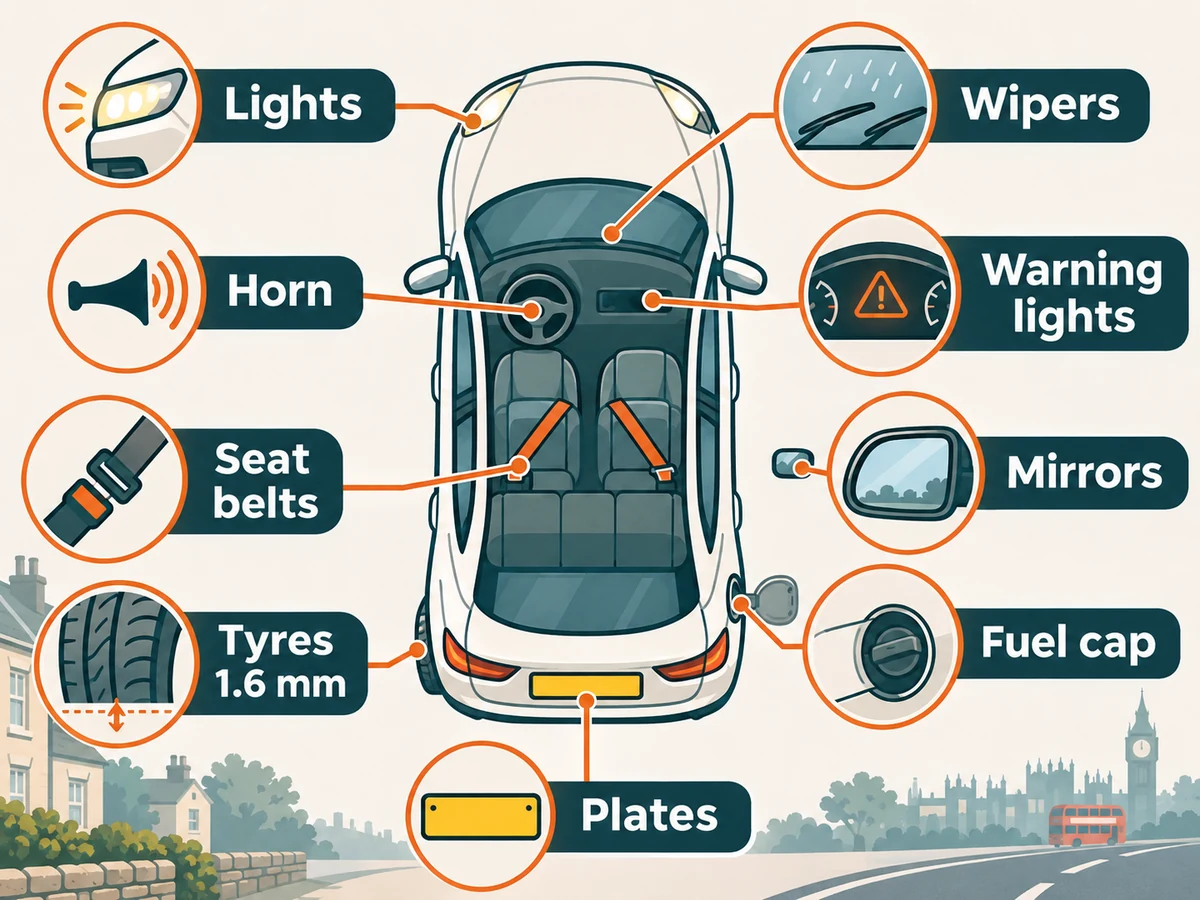
The quick checklist
- All lights working: headlights (dipped and main beam), sidelights, brake lights, indicators, hazards, fog lights, reversing lights, number plate lights
- Wiper blades not split or smearing; washers spray properly; screenwash topped up
- No windscreen damage in the driver's line of sight
- Tyres at least 1.6 mm tread, no cuts or bulges, correct pressures
- Horn works
- Seat belts undamaged, latch and release, retract properly
- Number plates clean, secure and legal
- Mirrors present, secure and undamaged
- No warning lights left on after starting the engine
- Fuel cap opens, closes and seals; key available
- Doors open and close from inside and out; bonnet and boot shut securely
- Car reasonably clean and clutter-free
Each check explained
Lights and bulbs
Section 4 of the manual, lamps, reflectors and electrical equipment, is the biggest category of MOT failure. Switch on each light in turn and walk round the car. Ask a helper to press the brake pedal and select reverse. Cars first used from 1 January 1971 must have two brake lights, one on each side. Indicators must show amber, and cars first used from 1 April 1986 need a side repeater on each side.
Don't miss the rear number plate lamp. If a plate has only one lamp, or none work, that is a major defect. Headlamp aim is also tested, which you can't easily check at home. A damaged or missing headlamp lens or reflector can count too.
Windscreen, wipers, washers and screenwash
The visibility section covers the driver's view. Damage more than 10 mm across in "zone A" (a 290 mm wide area of the swept screen centred on the steering wheel) or more than 40 mm elsewhere in the swept area is a defect. Get chips repaired early.
A defective wiper blade is a minor defect, but a blade missing or "obviously not clearing the windscreen" is major. Washers must give enough fluid for the wipers to clear the screen, so fill the screenwash before the test. Our guide to checking oil, coolant and screenwash shows where the reservoir is.
Mirrors
The tester checks you have the required mirrors, that they give an adequate view to the rear, and that they aren't missing, loose or badly damaged. Replace broken mirror glass.
Tyres and wheels
The legal minimum is 1.6 mm across the central three-quarters of the tread and around the entire circumference for cars (MOT manual section 5; Highway Code annex 6). Check each tyre in several places, look for cuts, bulges and exposed cord, and check the tyres are the right size and type for the car (check the handbook). Spare tyres aren't inspected. On cars first used from 1 January 2012, the tyre pressure monitoring (TPMS) light must work. See tyre tread and pressures.
Horn
Section 7 of the manual (other equipment) says the horn must be loud enough for other road users to hear. A horn that doesn't work is a defect. Give it a quick press.
Seat belts
Pull each belt all the way out and look along the webbing for cuts, fraying and damage. The manual says cuts on the webbing edge over 2 mm are likely to count as a defect. Buckle each belt, tug it, then check it releases and retracts. The airbag and seat belt pre-tensioner warning lights are checked too.
Number plates
Under section 0 of the manual, front and rear plates must show the same number and must not be obscured, badly damaged or delaminated. Characters must be the correct font, size and spacing, and tints or fixings that change how the characters look aren't allowed. Clean them, and replace cracked or faded plates.
Dashboard warning lights
With the ignition on, warning lights should come on and then go out once the engine starts. The MOT checks the warning lights for the engine, ABS, electronic stability control, electronic parking brake, brake fluid, power steering, airbags and seat belt pre-tensioners. An engine management light that is on, or indicating a malfunction, is a defect (section 8). Get a lit warning light diagnosed first: our dashboard warning lights guide explains them.
Fuel cap
The body and structure section treats a "missing or ineffective filler cap" as a fuel system defect. Check the seal is intact and it closes properly. If your cap locks, leave the key with the car: GOV.UK says the fuel cap will need to be opened.
Doors, bonnet, boot and seats
Front doors must open from inside and out, and rear doors from outside. The bonnet and boot must close securely, the driver's seat must adjust, and all seats must be secure (GOV.UK).
Clean and clear
The manual's introduction allows a tester to refuse a car that is so dirty examination is unreasonably difficult, or with a load that stops a proper test. They can also refuse if the fuel cap, doors, boot or bonnet can't be easily opened. Empty the boot and give the car a quick clean.
Two easy fixes: wiper blades and bulbs
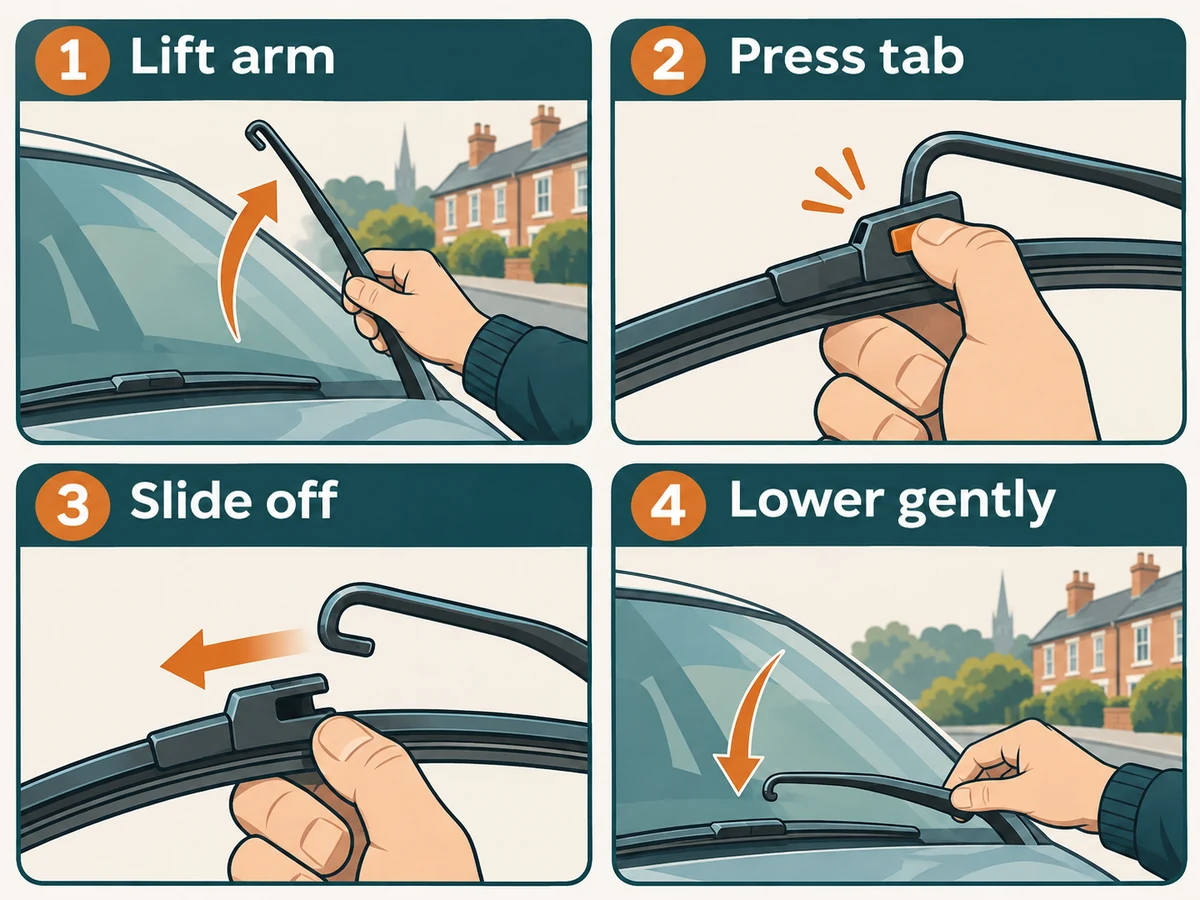
Changing a wiper blade
Most blades unclip from the wiper arm. Lift the arm away from the glass, press the release tab or slide the blade off the hook, and fit the new blade the same way until it clicks. Lower the arm gently: it can crack the glass if it snaps back. Blades come in different lengths and fittings, so check the handbook or a parts lookup for your car. Many rear wipers use a different fitting.
Changing a bulb
Many rear lamp, indicator and number plate bulbs are reachable from inside the boot or behind a small cover. Some headlamp bulbs need the bumper, wheel-arch liner or headlamp unit removed, and some cars use LED lamp units that can't be serviced as a bulb. Check the handbook first. If it says the job needs a garage, or you'd need to dismantle parts of the car, let a garage do it. Switch off the lights and let the bulb cool, and avoid touching the glass of halogen bulbs with bare fingers. Remember headlamp aim is tested, so a garage may need to check it after work on the headlamps.
Safety first
On hybrid and electric cars, keep away from orange cables. The MOT manual notes high-voltage insulation is orange (some imports differ), and 48V mild-hybrid wiring may be blue but should still be avoided.
What the MOT doesn't cover
GOV.UK is clear that the MOT is not a service: it "doesn't check its general mechanical condition", and the test doesn't cover the condition of the engine, clutch or gearbox (car parts checked at an MOT). A pass doesn't mean the car needs no work, so keep up with servicing as set out in the handbook.
FAQ
Will my car fail the MOT for an empty screenwash bottle?
It can. The MOT manual lists washers "not working or not providing sufficient fluid to clear the windscreen" as a major defect, so top up the screenwash before the test.
Does a warning light mean an automatic MOT fail?
Not every light, but several are checked. An engine management light that is on or indicating a malfunction is a defect in the MOT manual, and testers also check the warning lights for systems such as ABS, airbags and power steering. Get any lit warning light checked before the test.
Does the MOT check the spare tyre?
No. GOV.UK says spare wheels and tyres are not inspected, though it's still worth checking your spare is usable.
Sources
- Getting an MOT — GOV.UK, accessed 15 November 2026.
- Car parts checked at an MOT — GOV.UK (DVSA), accessed 15 November 2026.
- MOT inspection manual: introduction — GOV.UK (DVSA), accessed 15 November 2026.
- MOT inspection manual: 0. Identification of the vehicle — GOV.UK (DVSA), accessed 15 November 2026.
- MOT inspection manual: 3. Visibility — GOV.UK (DVSA), accessed 15 November 2026.
- MOT inspection manual: 4. Lamps, reflectors and electrical equipment — GOV.UK (DVSA), accessed 15 November 2026.
- MOT inspection manual: 5. Axles, wheels, tyres and suspension — GOV.UK (DVSA), accessed 15 November 2026.
- MOT inspection manual: 6. Body, structure and attachments — GOV.UK (DVSA), accessed 15 November 2026.
- MOT inspection manual: 7. Other equipment — GOV.UK (DVSA), accessed 15 November 2026.
- MOT inspection manual: 8. Nuisance — GOV.UK (DVSA), accessed 15 November 2026.
- The Highway Code, annex 6: vehicle maintenance, safety and security — GOV.UK, accessed 15 November 2026.