Guides · Basic jobs
Tyre tread depth and pressures: how to check them at home
The UK 1.6 mm tread law, how to measure tread with a gauge or 20p, where to find your tyre pressures, weekly cold checks, the TPMS light and space savers.
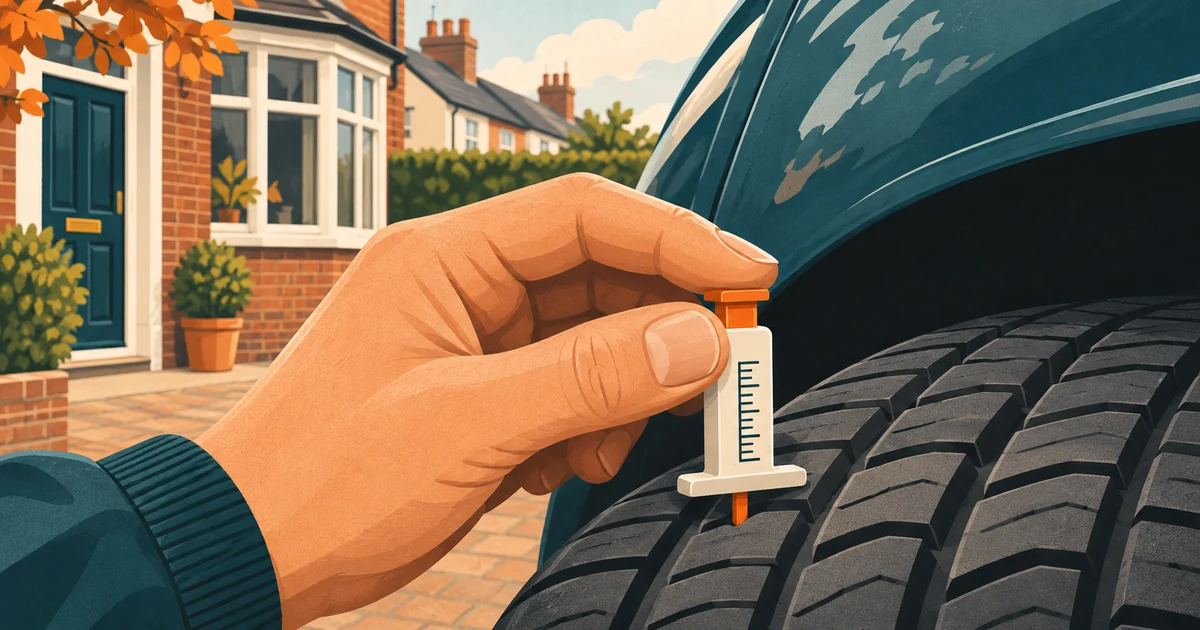
Your tyres are the only part of the car touching the road. Happily, they're also one of the easiest things to check on the driveway. Here's the legal tread depth, three ways to measure it, where to find the right pressures, why you check them cold, what the tyre pressure warning light means, and what to know about space-saver spares. Your owner's handbook is the final word on pressures and spare wheel limits for your car.
We haven't tested these products. This comparison is based on makers' published specifications and manuals, retailer listings and owner reviews (checked 15 November 2026).
The legal minimum: 1.6 mm
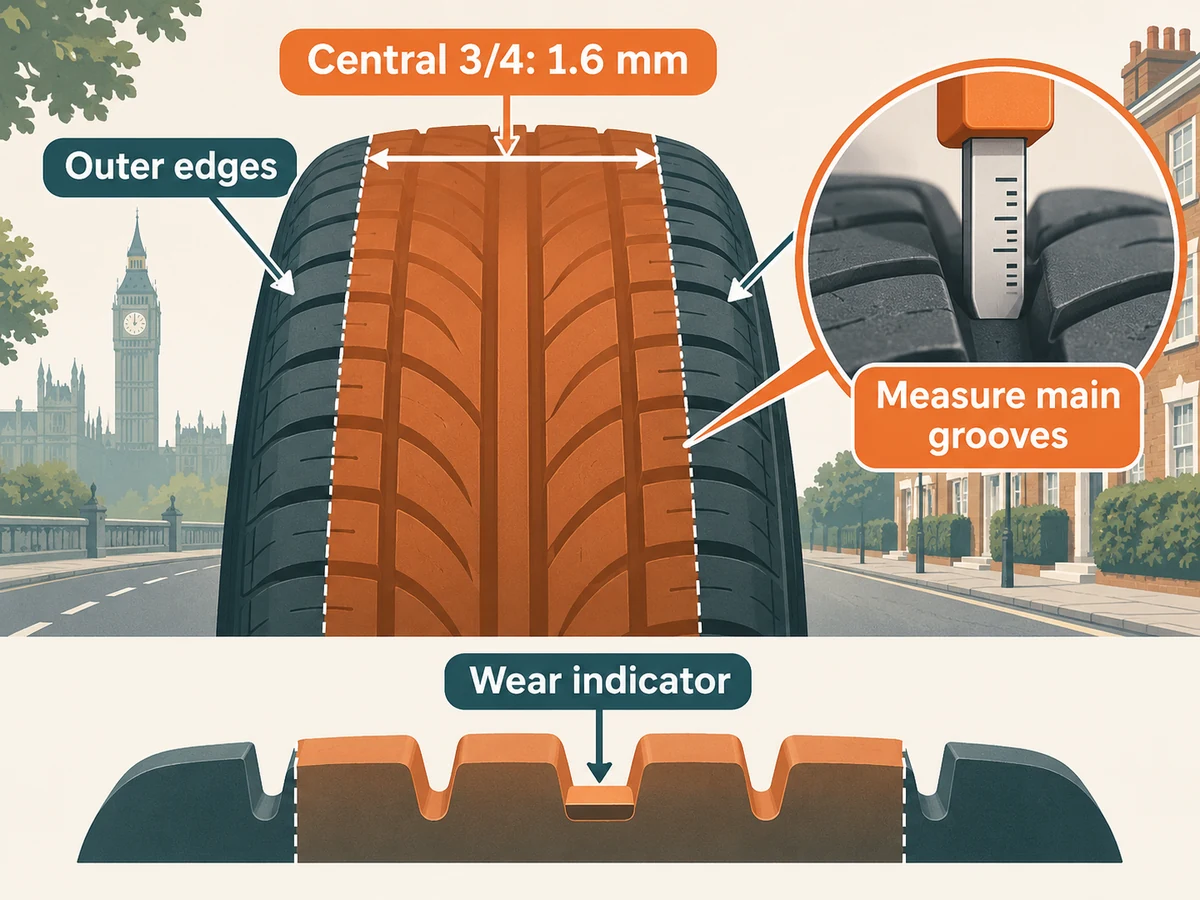
The Highway Code says cars, light vans and light trailers must have at least 1.6 mm of tread across the central three-quarters of the tread's width and around the entire circumference. Tyres should also be free from certain cuts and other defects. The RAC's guide to illegal tyres adds bulges and exposed cords to the list, along with the wrong size, load or speed rating for the car.
Legal isn't the same as good. The RAC's tread depth guide says most tyre and safety experts recommend replacing at 3 mm. It cites MIRA tests finding that wet braking distance can be up to 44% longer on tyres worn to 1.6 mm than on tyres at 3 mm.
On penalties, GOV.UK's endorsement codes list shows code CU30, "using a vehicle with defective tyre(s)", carrying 3 penalty points. The Highway Code also notes that some vehicle defects can attract penalty points. Tyres are part of the MOT too, so see our MOT checklist.
How to measure tread depth
Check each tyre at several points around it. Wear is often uneven, and the law applies around the whole circumference. The RAC suggests three methods.
1. Tread wear indicators
Many tyres have small raised bars moulded into the bottom of the main grooves. Their position is often marked by a small arrow or symbol on the shoulder. The RAC says that if the tread is flush with these bars, it may be at or below 1.6 mm and the tyre needs replacing.
2. A tread depth gauge
A gauge gives you an actual figure, which is useful for spotting uneven wear early. Push the probe into a main groove (not on a wear bar), press the body flat on the tread blocks, and read the depth. Repeat across the central three-quarters and at a few points around the tyre.
One example is the Sealey VS0568 pocket dial tread depth gauge, about £15 at Amazon UK (checked 15 November 2026). Its listing describes a steel body, a 0–11 mm scale in 1 mm graduations, and colour bands. Green is 11–3 mm, yellow is 2.99–1.6 mm ("advised to replace") and red is below 1.6 mm.
3. The 20p test
The RAC describes this quick check. Put a 20p coin into the main tread grooves. If you can't see the coin's outer band, the tread is above the legal limit. If you can see the band, the tyres could be unsafe and should be checked by a professional. The RAC suggests doing this about every two weeks and before long journeys. It's a rough guide, not a measurement, so use a gauge if you're close.
Worth knowing
Uneven wear tells you something. The Highway Code says excessive or uneven tyre wear may be caused by faults in the braking or suspension systems, or wheels out of alignment, and that you should have these faults fixed as soon as possible.
Tyre pressures: where to find the right figures
The Highway Code says tyres must be inflated to the vehicle maker's specification for the load being carried. Always refer to the handbook or data.
The RAC's tyre pressure guide says to look for the figures:
- in the owner's handbook
- on a sticker inside the driver's door frame
- sometimes on the inside of the fuel flap
You'll usually see several figures. They cover front and rear, normal load versus fully loaded (passengers plus luggage), and sometimes a comfort versus economy setting. Pick the one that matches how the car is loaded. Pressures are given in bar and PSI. The RAC notes that 1 bar is 14.5 PSI.
How to check pressures (weekly, when cold)
The Highway Code says to check weekly, before your journey, when tyres are cold, because warm or hot tyres may give a misleading reading. The RAC also recommends cold checks and says tyres naturally lose a little air every month.
- Park safely, engine off, handbrake on.
- Note the correct pressures for your load from the handbook or door sticker.
- Remove the valve cap and press the gauge or inflator connector squarely onto the valve.
- Read the pressure. Add air in small amounts, or let a little out, and recheck.
- Refit the valve cap. Do all four tyres, and the spare if you have one.
You can use a forecourt air machine, which usually lets you set the target pressure. Or you can use a 12V or cordless inflator at home. One example is the AstroAI 12V corded and 20V cordless tyre inflator, about £54 at Amazon UK (checked 15 November 2026). Its listing describes a 12V DC lead plus a rechargeable 20V battery pack, a backlit display, and auto shut-off at a preset pressure. A cheap pencil or digital gauge is still handy for double-checking any inflator's reading. Our best tyre inflator guide compares more options.
The Highway Code warns that under- or over-inflated tyres affect your brakes and steering. The RAC adds that under-inflation increases fuel use.
The tyre pressure warning light (TPMS)
Many cars have a tyre pressure monitoring system that lights an amber warning when pressure drops. Advice on what to do differs slightly:
- The RAC's warning lights guide says to stop as soon as it's safe, check your pressures, reduce speed, and avoid sudden braking or sharp steering.
- The AA's warning lights guide says it's safe only to finish your journey or drive to a garage. It adds that if the light keeps coming back after you've inflated the tyre, you may have a slow puncture.
The MOT inspection manual explains that the lamp normally lights briefly at start-up. It stays on if the system has detected a previous pressure loss, and may flash then stay on if the system itself has a fault. TPMS is checked at the MOT on passenger cars first used from 1 January 2012. Check your handbook to see whether the system needs resetting after you adjust pressures. Our knowledge-base answer why is my tyre pressure light on? has more.
Spare wheels and space savers
Check the spare's pressure along with the others. The AA's tyre change guide says a spare must have a legal, inflated tyre.
Space savers are narrower temporary spares. The RAC's space saver guide says they have shallower tread and a lower speed limit, typically below 50 mph. The AA says the limit is shown on a sticker on the wheel and in the handbook. Both say to use one only to reach a garage or home, then get the punctured tyre repaired or replaced. Many newer cars carry a sealant and compressor kit instead of a spare. The RAC describes these as a temporary fix. If you need to fit the spare, see how to change a wheel safely.
Storing seasonal tyres
If you swap between summer and winter tyres, check the tread and condition of the off-season set before refitting it, using the same gauge checks as above. Our sister site has practical ideas on storing tyres in a garage.
FAQs
What is the legal tyre tread depth in the UK?
For cars and light vans, it's 1.6 mm across the central three-quarters of the tread and around the whole circumference, according to the Highway Code. See what is the legal tyre tread depth?
How often should I check tyre pressures?
The Highway Code says weekly, before a journey, when the tyres are cold. The RAC says at least monthly. Weekly is the safer habit.
Should I use the higher "loaded" pressure all the time?
Use the figure that matches your load. The Highway Code says tyres must be inflated to the maker's specification for the load being carried. The door sticker and handbook list both.
Sources
- The Highway Code: Annex 6, vehicle maintenance, safety and security — Department for Transport, GOV.UK, accessed 15 November 2026.
- Tyre tread depth, UK law and tyre safety checks — RAC, accessed 15 November 2026.
- How to check your tyre pressure safely — RAC, accessed 15 November 2026.
- What makes your tyres illegal? The complete guide — RAC, accessed 15 November 2026.
- Space saver wheel guide — RAC, accessed 15 November 2026.
- Dashboard warning lights: all symbols explained — RAC, accessed 15 November 2026.
- Dashboard warning lights — The AA, accessed 15 November 2026.
- How to change a tyre — The AA, accessed 15 November 2026.
- MOT inspection manual: 5. Axles, wheels, tyres and suspension — DVSA, GOV.UK, accessed 15 November 2026.
- Penalty points (endorsements): endorsement codes and penalty points — GOV.UK, accessed 15 November 2026.
- Amazon UK product listings for the tread gauge and inflator named above, accessed 15 November 2026.