Guides · Basic jobs
How to check oil, coolant, screenwash and brake fluid
Step-by-step under-bonnet checks for engine oil, coolant, screenwash and brake fluid, with when to top up, when to stop, and EV and hybrid safety.
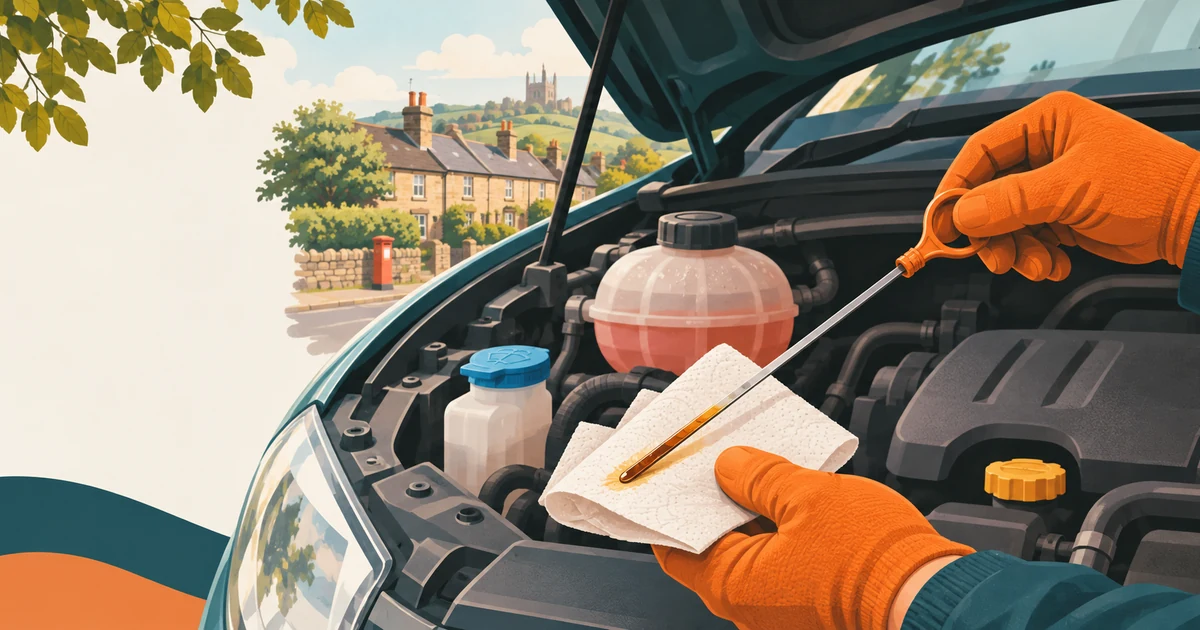
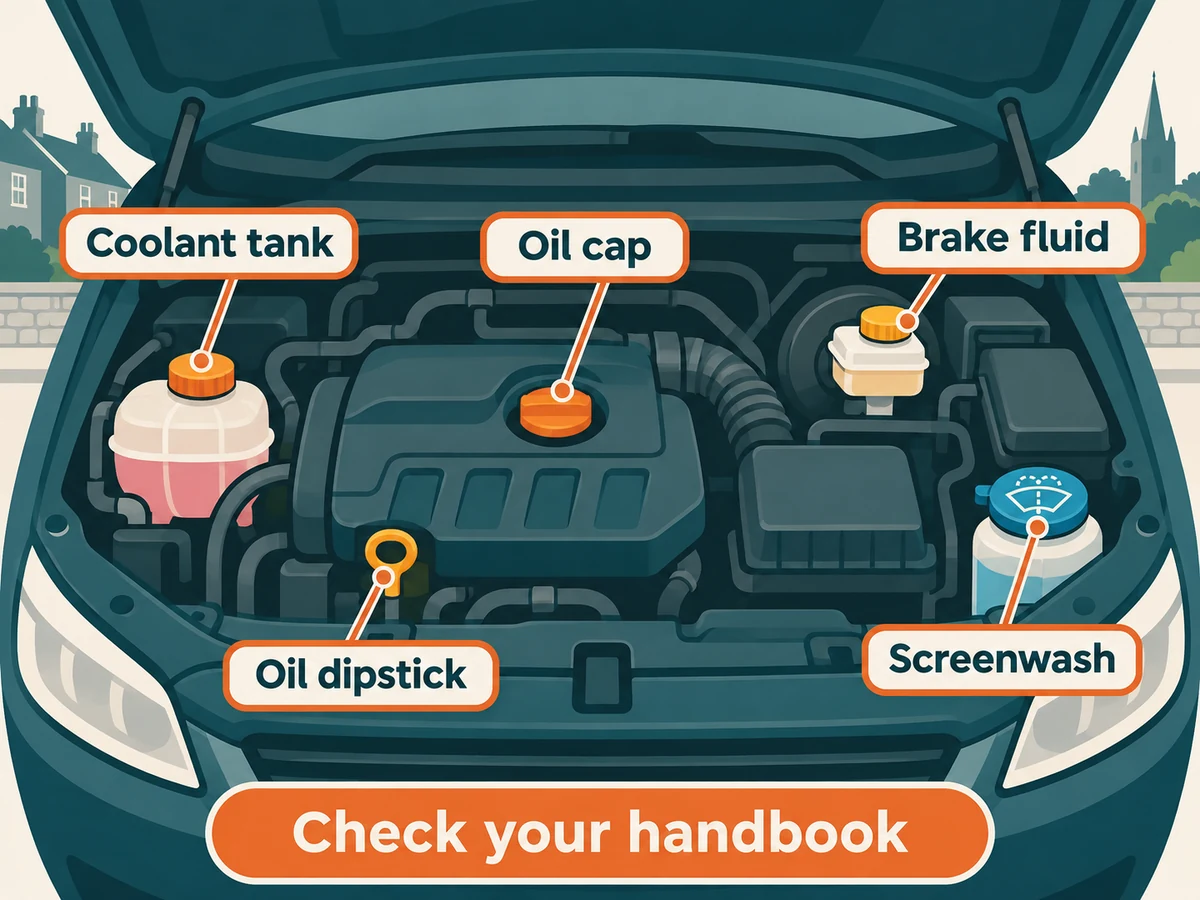
Bonnet up, five minutes, done. A quick look under the bonnet every week or two can catch a leak before it wrecks an engine, and the Highway Code says to check your car's fluid levels at least weekly. Here are the four you can check yourself (engine oil, coolant, screenwash and brake fluid), and when a low reading means a garage visit rather than a top-up. Engine layouts vary a lot, so keep your owner's handbook open. It shows where each filler and reservoir is and which fluids your car needs.
Before you start
- Park on level ground with the engine off and the handbrake on. Both the AA and RAC say a slope gives a false oil reading.
- Let the engine cool. Some parts stay hot for a long time, and coolant must only be checked cold (more on that below).
- Keep loose clothing, jewellery and long hair away from the engine bay. The AA's coolant advice warns that electric cooling fans can switch on even with the key removed.
- Have kitchen roll or a lint-free cloth, a funnel and gloves to hand.
Safety first
Hybrids and EVs: don't touch orange cables or the parts they connect to. The MOT inspection manual (section 20) says high-voltage wiring insulation is orange, though some imported cars differ. It adds that 48V mild-hybrid wiring may be blue and should still be avoided, and that a hybrid's engine may start without warning. Stick to the handbook's owner checks, keep hands clear of fans and belts, and leave anything else to a qualified technician. See is it safe to touch hybrid or EV cables?
Checking engine oil
The AA and RAC both suggest checking every few weeks and before long journeys. The RAC notes that older engines can develop leaks and even modern engines can burn some oil. Checking before the car's been used gives the best reading. If you've just driven, the AA says wait 5 to 10 minutes and the RAC says at least 10, so the oil can drain back to the sump.
- Find the dipstick. It usually has a brightly coloured handle. If you can't see one, check the handbook, because some cars only have an electronic oil level monitor that you read on the dashboard.
- Pull it out and wipe it clean. You'll see two marks, holes or a hatched area showing minimum and maximum.
- Push it fully back in, then pull it out again.
- Read the level. The top of the oil film should sit between the marks. The AA suggests adding some if it's below halfway, and says you must add oil if it's near or below the minimum.
- Top up a little at a time through the filler cap, which is usually marked with an oil can symbol. The AA says the gap between the marks is about a litre. Wait a couple of minutes, then recheck.
- Don't overfill. Both organisations warn that too much oil can also cause damage.
Using the right oil
Use the oil your handbook specifies. The AA says it needs both the right grade (such as 5W-30) and the right specification (for example ACEA, API or a maker's own standard). The wrong oil can damage the engine. The RAC adds that using the wrong grade on a car under warranty could invalidate the warranty.
What the oil tells you
Dark brown or black oil is normal in use. The AA flags two warning signs. Thick, sludgy black oil needs changing. Milky, creamy or foamy oil can mean coolant or water is getting in, which needs a mechanic. If you have to top up often, or the oil pressure light comes on, get it checked rather than just adding more. The AA also suggests topping up before an MOT, because the tester runs the engine for the emissions test.
Checking coolant
Coolant (water mixed with antifreeze) stops the engine overheating. The Highway Code says that if the engine overheats, you should wait until it has cooled naturally and only then remove the coolant filler cap.
Safety first
Only open the coolant cap when the engine is cold. The cooling system is pressurised, and the AA warns you could be scalded by a sudden release of hot water. The AA suggests waiting at least 30 minutes after switching off, and longer if the engine has overheated.
- Find the expansion tank. It's usually a translucent plastic bottle whose cap is marked "engine coolant", "never open when hot", or a warning symbol. Check the handbook. The AA warns that putting antifreeze in the screenwash, brake fluid or power steering reservoir could cause damage.
- Read the level through the side of the tank without opening it. It should be between the MIN and MAX marks.
- Top up only if needed, with the engine cold, using the coolant type in your handbook. The AA says different antifreeze types don't mix well. Some makers specify a pre-mixed coolant; others a set mix of antifreeze and water.
- Look at the hoses you can see. The AA says wet patches or white staining are signs of trouble ahead.
How often should you check? The AA suggests every couple of weeks. The RAC's coolant guide says at least twice a year, ideally before summer and winter, and says to follow your handbook. Most modern systems are sealed, so the AA says a dropping level isn't normal and needs a garage check. Both say plain water is only an emergency measure to reach a garage. Too much water weakens frost protection and lowers the boiling point.
If a coolant or temperature warning appears while you're driving, the RAC says stop when it's safe and call for help, rather than risk engine damage.
Checking screenwash
The RAC's screenwash guide says the washer bottle usually has a blue cap with a windscreen symbol.
- Engine off, open the bonnet and find the washer bottle.
- Remove the cap and pour in ready-mixed screenwash, or concentrate diluted as the label says, until it's nearly full. The RAC notes that most washer bottles have no MIN or MAX marks.
- Refit the cap and test the washers.
Plain water cleans poorly and can freeze. The RAC suggests a winter or all-season screenwash with antifreeze additives in cold weather. The RAC also says there's no specific law that the bottle must be full, but your washers must work if the car was built with them. Driving with poor visibility could lead to penalties and may cause an MOT failure.
Checking brake fluid (look, don't touch)
Brake fluid is a look-only check for owners. The Highway Code warns that low brake fluid may cause brake failure and a crash. It also says to learn the low-fluid warning light if your car has one.
- Find the brake fluid reservoir. Your handbook shows where it is.
- Read the level through the translucent reservoir without removing the cap. MOT testers work the same way: the MOT inspection manual's brakes section says they check the level only on see-through reservoirs and don't remove the cap.
- If the level is at or below MIN, don't just top it up. A low level needs a garage to find out why.
For scale, the MOT manual classes brake fluid below the minimum mark as a minor defect. Significantly below minimum is a major defect, and no fluid visible is dangerous.
Garage tip
A warning light or a low reading is a reason to investigate, not to keep topping up. If oil, coolant or brake fluid keeps dropping, book the car in. Our guide to garage repairs and your rights explains how to get a written quote.
A quick weekly routine
| Check | How often (source) | Low reading means |
|---|---|---|
| Engine oil | Every few weeks and before long trips (AA, RAC) | Top up with the handbook grade; recheck |
| Coolant | Every couple of weeks (AA); at least twice a year (RAC) | Top up cold; repeated drops need a garage |
| Screenwash | Before long trips and in winter | Refill with the right screenwash |
| Brake fluid | With your weekly fluid check (Highway Code) | Garage: don't just top up |
| All fluids | At least weekly (Highway Code) | — |
Pair this with a tyre tread and pressure check and you've covered most of the basics before an MOT.
FAQs
Can I check oil with a warm engine?
Yes. Both the AA and RAC say a cold engine gives the most accurate reading, but you can check after a short wait: the AA says 5 to 10 minutes, the RAC at least 10. Park on level ground and take care around hot parts.
Can I top up coolant with water?
Only in an emergency to reach a garage, say the AA and RAC. Use the coolant type in your handbook. Too much water weakens antifreeze protection.
Should I top up brake fluid myself?
We'd say no. Look at the level through the reservoir, and if it's low, have a garage find out why. The Highway Code warns that low brake fluid may cause brake failure.
Sources
- How to check and top up your car engine oil — The AA, accessed 15 November 2026.
- How to check your engine oil: a step-by-step guide — RAC, accessed 15 November 2026.
- How to check your engine coolant and top it up — The AA, accessed 15 November 2026.
- How to check your engine coolant — RAC, accessed 15 November 2026.
- How to check windscreen wash — RAC, accessed 15 November 2026.
- The Highway Code: Annex 6, vehicle maintenance, safety and security — Department for Transport, GOV.UK, accessed 15 November 2026.
- MOT inspection manual: 1. Brakes — DVSA, GOV.UK, accessed 15 November 2026.
- MOT inspection manual: introduction — DVSA, GOV.UK, accessed 15 November 2026.