Guides · Costs and rights
Garage repairs and your rights: when to use a garage, quotes and the Consumer Rights Act
Which car jobs to leave to a garage, how to choose one, quote vs estimate, and your Consumer Rights Act 2015 rights when a repair or service goes wrong.
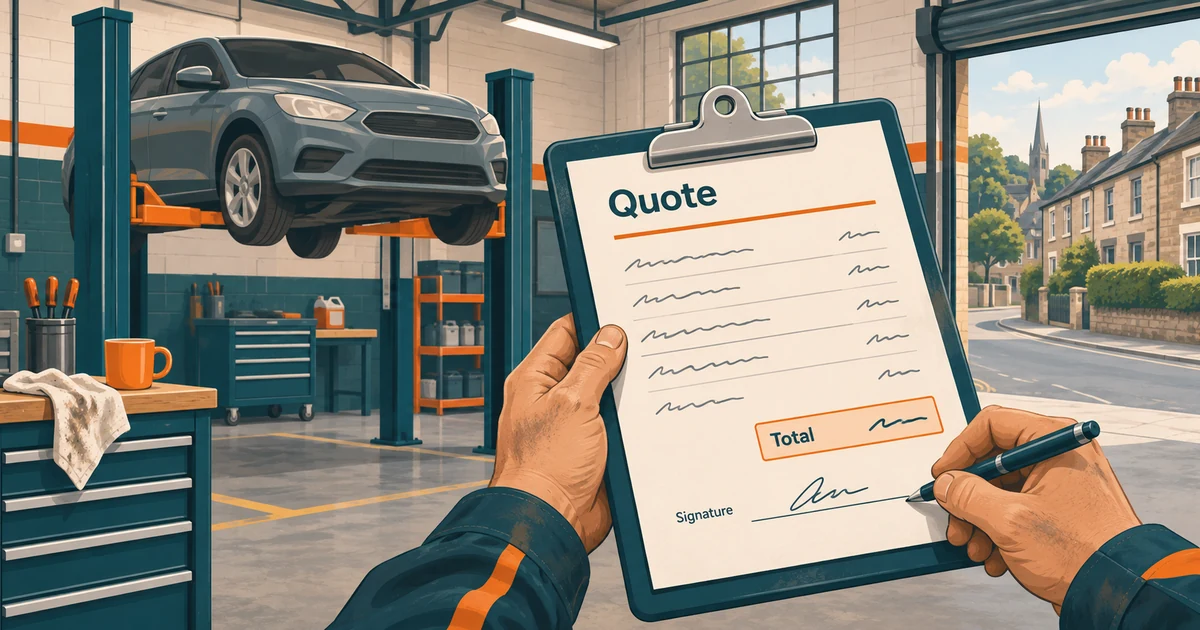
Checking fluids, swapping wiper blades and changing a wheel are sensible jobs for the driveway. Some work belongs with a qualified mechanic, though, because if it goes wrong, someone gets hurt. Here's which jobs to hand over, how to pick a garage, why a written quote matters, and what the Consumer Rights Act 2015 gives you when a repair or service isn't done properly. It's general information, not legal advice. Citizens Advice can help with your own case.
Jobs to leave to a garage
Here's a simple test. If a mistake could stop the car steering, stopping or protecting you in a crash, or could give you an electric shock, book a professional.
- Brakes. Pads, discs, callipers, pipes and brake fluid all count. The Highway Code's vehicle maintenance annex warns that low brake fluid may cause brake failure and a crash. It also says a car that pulls to one side under braking most likely has a brake fault or wrong tyre pressures, and to consult a garage or mechanic straight away.
- Steering and suspension. That covers track rod ends, ball joints, power steering and shock absorbers. The same annex says worn shock absorbers can seriously affect how a car handles and should be replaced.
- Airbags and the SRS system. Airbag modules and seat belt pretensioners hold explosive charges. Leave any SRS warning light, or any work near the steering wheel, seats or pillar trims, to a garage.
- High-voltage parts on hybrids and EVs. The MOT inspection manual (section 20) tells testers to avoid touching high-voltage components and wiring. It says high-voltage insulation is orange, though some imported cars use other colours, and 48V mild-hybrid wiring may be blue and should still be avoided. It also warns that a hybrid's petrol engine may start without warning. Owners shouldn't go near these parts either.
- Anything that needs the car raised without proper support. If a job means getting under the car and you only have the jack from the boot, it's a garage job. The Health and Safety Executive's leaflet Working safely under motor vehicles being repaired says never work beneath a vehicle supported only on jacks. Use axle stands on a hard, level surface and chock the wheels that stay on the ground. See can I work under a car on a jack?
Stop driving
If a red warning light comes on, or the brakes, steering or tyres feel wrong, stop when it's safe and get help. Don't try a roadside fix. The Highway Code says that if warning lights stay on after the engine starts, or come on while you're driving, you should stop and investigate because you could have a serious fault. Our dashboard warning lights guide explains what each light means.
Choosing a garage
Citizens Advice suggests using an approved garage for servicing, repairs and MOTs. It means one signed up to a Motor Industry Code of Practice for Service and Repair. Those garages have clear complaints procedures. If you can't sort a problem out with them, you can also complain through a trade association. Citizens Advice points you to garages accredited by The Motor Ombudsman. That's an ombudsman for the motor industry that runs Chartered Trading Standards Institute-approved Codes of Practice, including a Service and Repair Code, and helps settle disputes. It says over 7,500 businesses are accredited to one or more of its Codes.
Before you book, it's worth:
- checking whether the garage belongs to an approved code or trade association
- asking how it handles complaints and whether it uses an alternative dispute resolution (ADR) scheme
- asking whether it works on your type of car (some independent garages don't take on high-voltage hybrid or EV work)
- getting a second quote for big jobs. Our car repair costs guide gives published average prices to compare against
Get a written quote, not just an estimate
A quote and an estimate are not the same thing. Citizens Advice's page on problems with a car repair explains the difference:
| Quote | Estimate | |
|---|---|---|
| What it is | A promise to do the work at an agreed price | The trader's best guess at the cost |
| Can the bill go up? | You'll usually pay the agreed amount; more than that may be challengeable if unreasonable | The trader can charge more "within reason" |
| What it should show | The work to be done and the price | Often less detail |
Ask for the quote in writing or by email. It should list the work, parts and labour. Be careful with open instructions too. Citizens Advice says that if you tell a garage to "do whatever needs to be done", you've given it the right to decide what work to do. You'll then have to pay if the work was necessary and the price reasonable. Asking the garage to phone you before going over a set figure keeps you in control.
Section 50 of the Act matters here too. Section 50 says that anything the trader says or writes about the service becomes a term of the contract if you took it into account when deciding to go ahead. So a promised completion date, or a "we'll fit genuine parts" line in an email, can count.
Your rights under the Consumer Rights Act 2015
A car service or repair is a contract to supply a service. The Act puts these terms into it automatically:
- Reasonable care and skill. Section 49 says every contract to supply a service includes a term that the trader must perform it with reasonable care and skill.
- A reasonable price if none was agreed. Under section 51, if no price was fixed and none was said, you must pay a reasonable price "and no more". What's reasonable is a question of fact.
- A reasonable time if none was agreed. Section 52 says that where no time was fixed, the trader must do the work within a reasonable time. Again, that's a question of fact.
What you can ask for
If the work doesn't meet the contract, section 54 gives you two remedies:
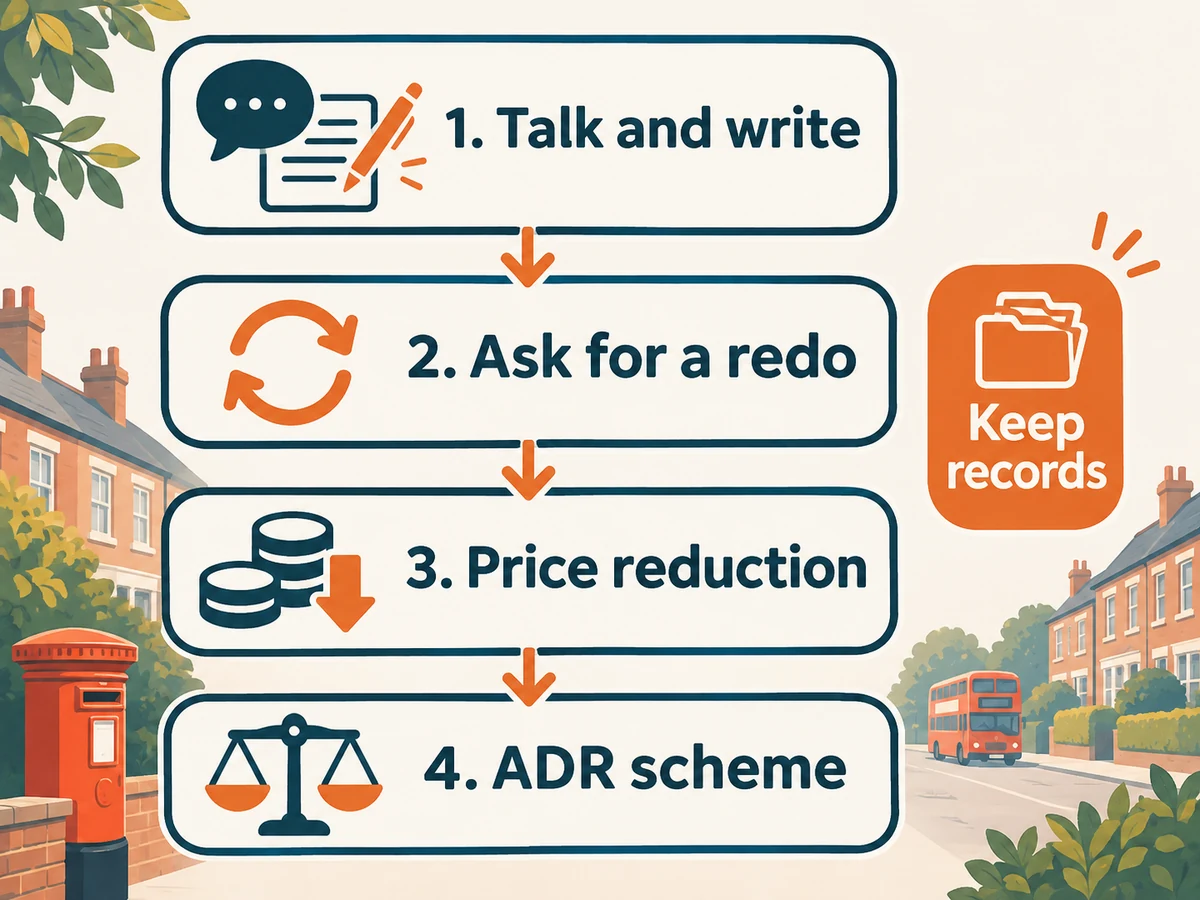
- Repeat performance. Under section 55, the garage must do the work again to the extent needed to get it right. It must do this within a reasonable time, without significant inconvenience to you, and at its own cost for labour and materials.
- A price reduction. Under section 56, you can claim an appropriate reduction, which can be the full price. This normally applies only if repeat performance is impossible, or the garage fails to redo the work within a reasonable time and without significant inconvenience. Any refund must be paid within 14 days of the trader agreeing you're owed one, by the same payment method, with no fee.
If the garage misses a reasonable time, section 54 says you're entitled to a price reduction. The Act also leaves room for other remedies, such as claiming damages. And section 57 stops a garage's terms from excluding its duty of reasonable care and skill. So a "no liability" notice on the wall doesn't remove your rights. Citizens Advice notes that a sign saying the garage isn't responsible for damage can be an unfair term.
How Citizens Advice suggests you handle it
Citizens Advice's car repair guidance (written for England, with separate pages for Scotland, Wales and Northern Ireland) recommends these steps:
- Talk to the garage first, in person or by phone. Then follow up in writing so you have a record.
- Ask it to fix faults that weren't repaired properly, weren't correctly found, or didn't exist before the car went in.
- Get a second opinion. A written quote from another garage, or an agreed independent engineer's report, can show the work wasn't done properly.
- Point out damage quickly. If the garage damaged the car, the most it has to offer is the cost of repairing that damage.
- Pay "under protest" if you need the car back. Write "paying under protest" clearly on the garage's copy of the repair order and any receipts. Citizens Advice says the garage can keep your car while a bill is disputed but isn't allowed to sell or get rid of it.
- Escalate. Use the garage's trade association if it's a member, or an ADR scheme. You can also report misleading pricing to Trading Standards.
Citizens Advice also mentions chargeback through your bank and, for credit card payments over £100, a section 75 claim. Keep receipts for any extra travel costs and ask about a courtesy car before hiring one. It says a court isn't likely to award you money if the garage offered help you didn't use.
Worth knowing
You don't always spot a bad repair straight away. Citizens Advice's service complaints page says you can ask for things to be put right for up to 6 years in England, Wales and Northern Ireland, and up to 5 years in Scotland. If you told the trader the service was fine when it was done, you may lose the right to have it redone or get a discount.
For a short answer you can bookmark, see what are my rights if a garage repair goes wrong?
FAQs
Do I have to pay more than the quote?
If you agreed a price or got a quote before the work, Citizens Advice says you'll normally have to pay the agreed amount. If the garage charges more than that and you think it's unreasonable, you can take it further. With only an estimate, the garage can charge more within reason.
The garage did work I didn't ask for. Do I have to pay?
If you asked for a specific job and the garage did extra work without agreement, Citizens Advice says you can ask it to undo the work. If that's not possible, insist on paying only for what was agreed.
Can I go straight to a refund?
Not usually. The Act gives the trader the chance to redo the work first. Citizens Advice says you can go straight to a price reduction if redoing it is impossible, would take too long, or would be very inconvenient for you.
Sources
- Consumer Rights Act 2015, section 49 — legislation.gov.uk, accessed 15 November 2026.
- Consumer Rights Act 2015, section 50 — legislation.gov.uk, accessed 15 November 2026.
- Consumer Rights Act 2015, section 51 — legislation.gov.uk, accessed 15 November 2026.
- Consumer Rights Act 2015, section 52 — legislation.gov.uk, accessed 15 November 2026.
- Consumer Rights Act 2015, section 54 — legislation.gov.uk, accessed 15 November 2026.
- Consumer Rights Act 2015, section 55 — legislation.gov.uk, accessed 15 November 2026.
- Consumer Rights Act 2015, section 56 — legislation.gov.uk, accessed 15 November 2026.
- Consumer Rights Act 2015, section 57 — legislation.gov.uk, accessed 15 November 2026.
- Problem with a car repair — Citizens Advice, accessed 15 November 2026.
- Find an approved garage — Citizens Advice, accessed 15 November 2026.
- If you're unhappy about poor service — Citizens Advice, accessed 15 November 2026.
- The Motor Ombudsman — The Motor Ombudsman, accessed 15 November 2026.
- MOT inspection manual: introduction — DVSA, GOV.UK, accessed 15 November 2026.
- Working safely under motor vehicles being repaired (INDG434) — Health and Safety Executive, accessed 15 November 2026.
- The Highway Code: Annex 6, vehicle maintenance, safety and security — Department for Transport, GOV.UK, accessed 15 November 2026.