Guides · Tools and kit
Best tyre inflator UK: corded 12V and cordless compressors compared
Corded 12V and cordless tyre inflators compared by published specs, auto-stop and gauge features, with how to set the right pressure and check it accurately.
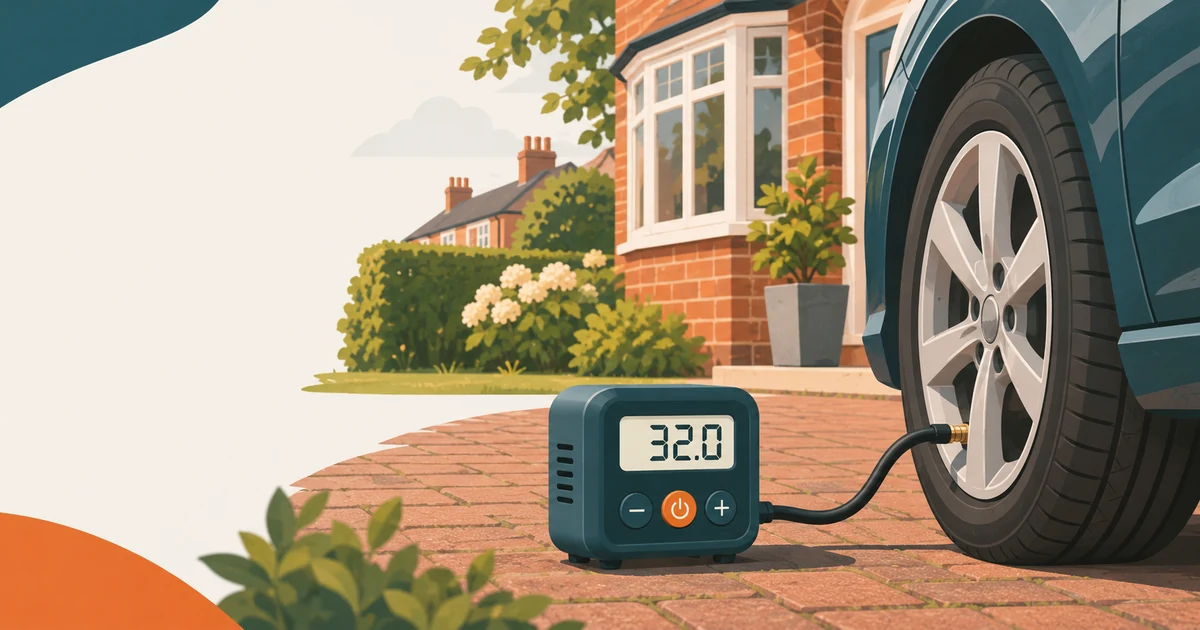
No more wrestling with the forecourt air machine. A tyre inflator makes weekly pressure checks easy to keep up at home. Modern ones have a digital display and auto-stop: you set the target pressure and the pump switches off when it gets there. The main choice is corded, plugging into your car's 12V socket, or cordless with a built-in battery. Here are three inflators on sale in the UK compared, plus how to get the pressure right.
We haven't tested these products. This comparison is based on makers' published specifications and manuals, retailer listings and owner reviews (checked 15 November 2026).
Quick comparison
| Inflator | Type | Key published spec | Price seen at Amazon UK |
|---|---|---|---|
| Ring UltraInflate 30 | Corded 12V | Auto-stop dial; 0–100 PSI display; 3.5 m cable | about £42, checked 15 November 2026 |
| AstroAI 12V corded and 20V cordless | Dual power (12V lead or battery) | Up to 160 PSI; 20 V 37 Wh battery; auto shut-off | about £54, checked 15 November 2026 |
| AstroAI cordless 150 PSI | Cordless, pocket size | 460 g; 4,000 mAh battery; preset and auto-off | about £25, checked 15 November 2026 |
Why pressure matters, and how often to check
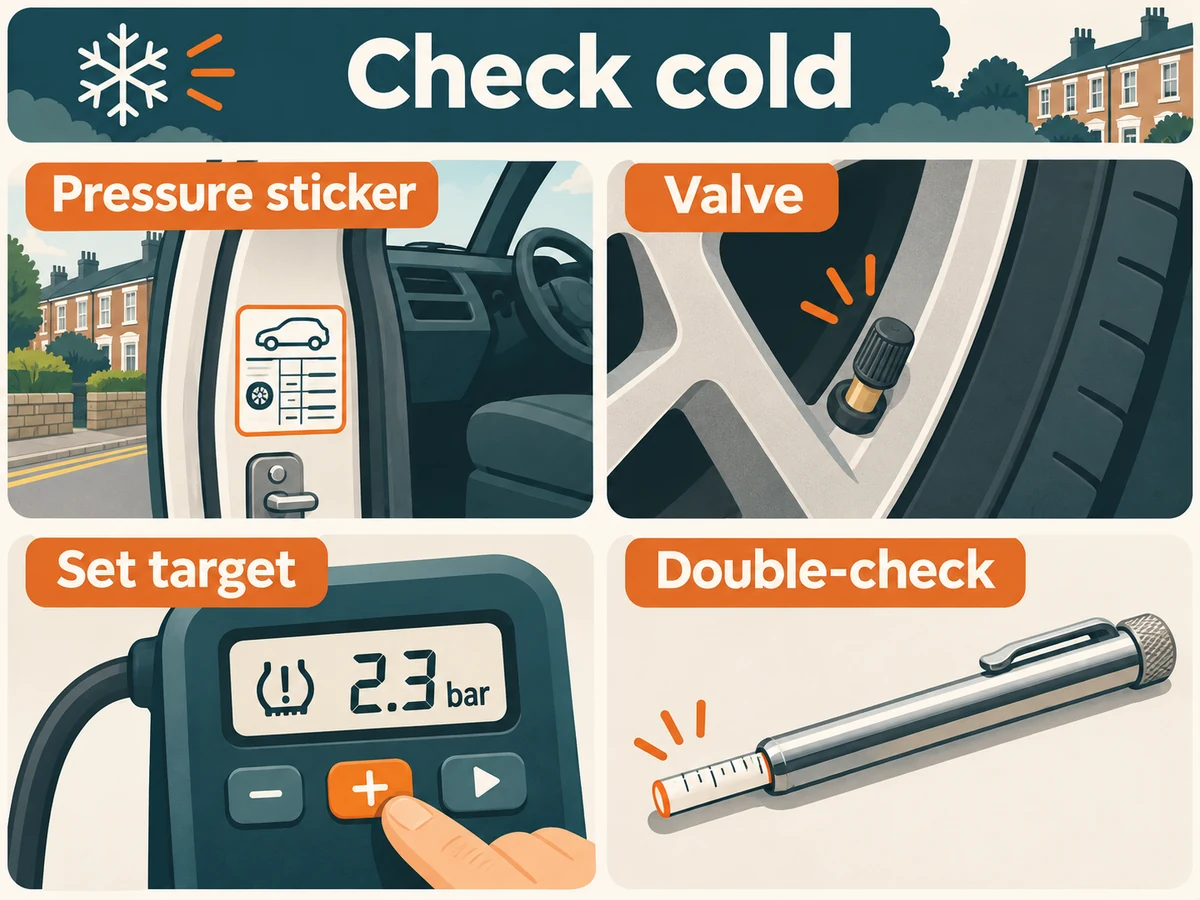
The Highway Code annex 6 says to check tyre pressures weekly, before your journey, when the tyres are cold, because warm or hot tyres can give a misleading reading. The RAC's tyre pressure guide explains that incorrectly inflated tyres affect handling and grip, and that underinflated tyres need more force (and fuel) to turn. It recommends at least monthly checks; weekly, as the Highway Code says, is better, and an inflator at home makes that realistic.
Where to find the right pressure
The RAC says the correct pressure is in the owner's manual and on a sticker inside the driver's door frame (sometimes on the fuel filler flap), given in PSI and bar. There are often different figures for a lightly loaded car and a fully loaded one, so pick the line that matches how you're travelling. Don't use the maximum pressure moulded on the tyre sidewall; that isn't your target. If 1 bar is easier for you, the RAC gives the conversion as 1 bar = 14.5 PSI.
Corded 12V or cordless?
Corded 12V inflators run from the car's 12V socket. They never run out of charge and tend to have steady power for repeated use. The trade-off is the cable: check it reaches all four tyres from the socket on your car. Check the manual on whether to run the engine while inflating, and if you do, only ever do it outdoors.
Cordless inflators have a rechargeable battery. They're quicker to grab for a top-up and handy for bikes and balls, but the battery has to be charged, and a small pack may only manage a few car tyres per charge.
Dual-power models offer both, which is useful if you sometimes need to inflate a very low tyre and don't want the battery to run out.
Auto-stop and duty cycle
Auto-stop is the single most useful feature: set the target and walk round to the next wheel. Look also for a stated continuous run time. Small compressors get hot, and the maker's run-time and cool-down instructions matter if you're filling a very low tyre or doing all four.
Gauge accuracy: check with a separate gauge
An inflator's built-in gauge is convenient, but readings from a pump connected to the valve can differ from a standalone gauge. The RAC recommends a good-quality tyre pressure gauge. Inflate with the pump, then check each tyre with a separate gauge you trust, adding small amounts of air at a time to avoid over-inflating, as the RAC suggests. If the two disagree consistently, adjust your target on the pump.
The inflators
Ring UltraInflate 30 corded 12V inflator
Suits: drivers who want a simple corded pump that lives in the boot.
Published specs: the listing describes a 180 W motor that inflates a 13-inch tyre to 35 PSI in about two minutes, an auto-stop dial that remembers the last pressure used, a backlit display reading PSI, bar and kPa over 0–100 PSI, a 3.5 m fused 12V cable, a 70 cm hose with brass connector and deflate button, an LED light, a storage case and three valve adaptors.
Limits: needs the car's 12V socket and a cable that reaches every wheel; the timing figure is for a 13-inch tyre, so larger tyres will take longer.
AstroAI dual-power inflator, 12V corded and 20V cordless
Suits: people who want cordless convenience with a 12V lead as back-up, including SUV owners.
Published specs: the listing gives a 12V DC cord plus a detachable 20 V 37 Wh battery that charges in about two hours by USB and can power devices. It quotes up to 160 PSI, 20 minutes' continuous running, a 150 W motor, a 195/65 R15 tyre fully inflated in about four minutes, auto shut-off with memory, a backlit display in bar, kPa and PSI with stated accuracy of ±0.5 PSI, an LED light and overheat and overcurrent protection.
Limits: the listing says it isn't for heavy-duty truck tyres. As with any built-in gauge, check the result with a separate gauge.
AstroAI cordless 150 PSI inflator
Suits: topping up small and medium car tyres, bikes and balls; tiny enough for a glovebox.
Published specs: the listing gives 150 PSI maximum, 17 L/min airflow, 30 to 36 PSI on a 195/65 R15 tyre in about 1.5 minutes, a 4,000 mAh battery good for up to eight such top-ups per charge, 460 g weight, five modes and four pressure units, presets from 3 to 150 PSI with auto-off, a torch and USB-C charging.
Limits: the listing says it isn't compatible with off-road vehicles, motorhomes, trucks or trailers. It's built for top-ups, not reinflating a completely flat tyre.
How to choose
- How low do your tyres get? For weekly top-ups, a small cordless pump is plenty. For a tyre that's well down, a corded or dual-power model with a stated run time is more dependable.
- What size are your tyres? Larger SUV tyres take longer to fill. Check the listing's examples against your tyre size (it's on the sidewall, for example 195/65 R15).
- Units and display. Choose one that shows both PSI and bar, matching your door sticker.
- Cable or hose length. For corded pumps, check the cable reaches the rear tyre on the far side.
- Separate gauge. Budget for a standalone gauge as a cross-check.
Safety
- Check pressures cold, as the Highway Code says, and adjust to the handbook figure for your load.
- An inflator won't fix a puncture. The RAC notes slow punctures cause steady pressure loss and that puncture repair kits are only a temporary fix. If a tyre keeps losing air, have it inspected.
- Inspect for cuts, bulges and tread depth while you're there. The Highway Code says cars must have at least 1.6 mm of tread across the central three-quarters of the tyre and around its full circumference. See our guide to tyre tread and pressures.
- Check the spare's pressure too, as the RAC suggests. If you ever need to fit it, the AA's tyre-change guide suggests looking up the correct pressure in the handbook at the same time as the jacking point.
- A tyre pressure warning light means at least one tyre may be low. See why is my tyre pressure light on? and check your handbook for how to reset the system.
FAQ
How often should I check my tyre pressures?
The Highway Code says weekly, before a journey, with the tyres cold. The RAC says at least once a month. Also check before a long trip or when carrying a heavy load.
Are inflator gauges accurate?
Some listings quote an accuracy figure, but treat the built-in gauge as a guide. The RAC recommends a good-quality pressure gauge, so check with a separate gauge after inflating.
Can I use the pressure printed on the tyre?
No. The figure on the sidewall is the tyre's maximum, not the recommended pressure for your car. Use the handbook or the door-frame sticker, as the RAC advises.
Sources
- The Highway Code: annex 6, vehicle maintenance, safety and security — GOV.UK, accessed 15 November 2026.
- How to check your tyre pressure safely — RAC, accessed 15 November 2026.
- How to change a tyre — The AA, accessed 15 November 2026.
- Amazon UK product listings for each inflator named above (linked in each product box), accessed 15 November 2026.