Guides · Tools and kit
Best jump starter and battery charger UK: jump packs, smart chargers and leads compared
Lithium jump packs, smart battery chargers and classic jump leads compared by published specs, with AA and RAC safety steps for getting a flat battery going.
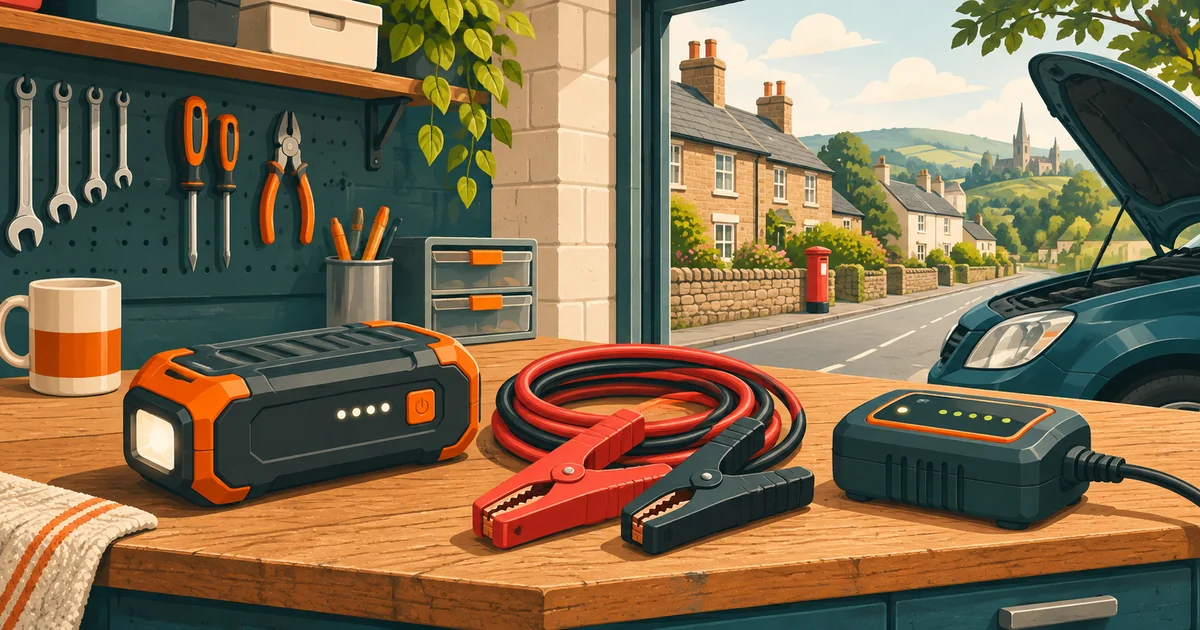
You turn the key and get a click, or nothing at all. A flat battery is one of the most common reasons a car won't start, and three tools deal with it in different ways. Jump leads borrow power from another car. A jump pack (booster pack) is a portable battery that does the same job without a second car. A smart charger refills and maintains the battery from the mains at home. Here's which one you need, five products on sale in the UK compared, and the AA and RAC safety steps you shouldn't skip.
We haven't tested these products. This comparison is based on makers' published specifications and manuals, retailer listings and owner reviews (checked 15 November 2026).
Quick comparison
| Product | Type | Key published spec | Price seen at Amazon UK |
|---|---|---|---|
| NOCO Boost X GBX45 | Lithium jump pack | 1,250 A; petrol up to 6.5 L, diesel up to 4.0 L | about £119, checked 15 November 2026 |
| NOCO Boost GB70 | Lithium jump pack | 2,000 A peak; petrol up to 8.0 L, diesel up to 6.0 L | about £178, checked 15 November 2026 |
| NOCO GENIUS5 | Smart charger and maintainer | 5 A; 6 V and 12 V lead-acid, 12 V lithium | about £74, checked 15 November 2026 |
| CTEK CT5 Start/Stop | Smart charger and maintainer | 12 V AGM and EFB batteries | about £79, checked 15 November 2026 |
| AA AA4550 jump leads | Jump leads | 3 m; engines up to 3,000 cc | about £14, checked 15 November 2026 |
Jump pack, jump leads or charger?
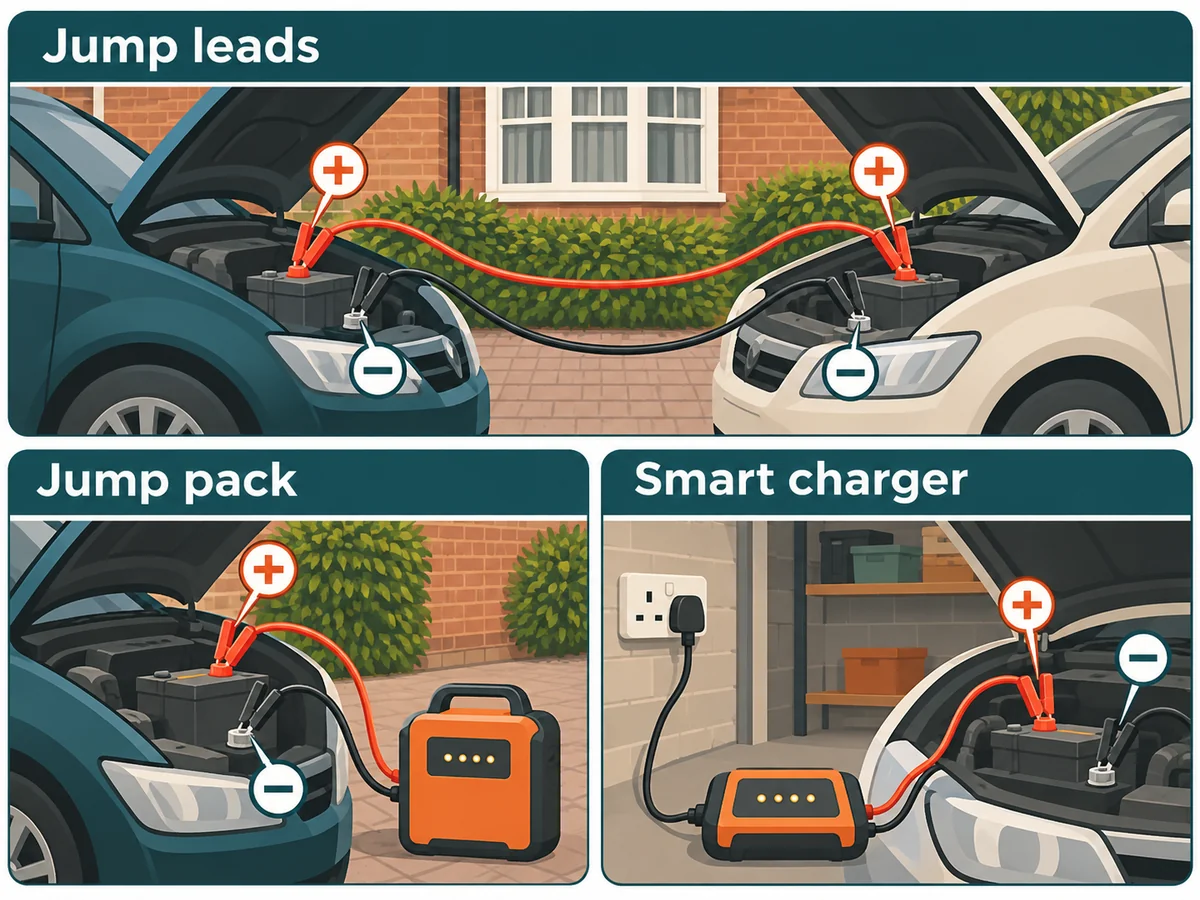
Jump leads are cheap and need no charging, but you need a second car with a healthy battery of the same voltage, parked close enough. The AA says to avoid using a hybrid or electric car as the donor, and the RAC says not to unless the manufacturer specifically permits it.
A jump pack gets you going alone, which matters on a dark lay-by or in a car park. It must be kept charged, and it only starts the car; it doesn't recharge a weak battery properly.
A smart charger is for home. It recharges a flat (not dead) battery and, left connected, keeps a battery topped up on a car you don't use much. The AA's flat battery advice says you can leave an intelligent charger connected for long periods without damaging the battery, and that EFB and AGM batteries need a smart charger. If your car is laid up for weeks, our sister site has a guide to using a battery maintainer on a stored car.
Many home mechanics end up with leads or a pack in the boot and a charger in the garage.
The jump packs
NOCO Boost X GBX45 jump starter, 1,250 A
Suits: most small and medium petrol and diesel cars, kept in the boot or glovebox.
Published specs: the listing gives a 1,250 A rating for petrol engines up to 6.5 litres and diesels up to 4.0 litres, spark-proof and reverse-polarity protection, up to 8 jump starts per charge, and a 60-second timer. It says it recharges in 48 minutes from a 60 W USB-C Power Delivery charger (not included), doubles as a 60 W USB-C power bank, and has a 100-lumen torch.
Limits: the fast-charge figure needs a charger you may not own. Check the engine size limits against your car.
NOCO Boost GB70 jump starter, 2,000 A
Suits: larger engines, big diesels and households with several vehicles.
Published specs: the listing gives 2,000 A peak, up to 40 starts per charge on engines up to 8.0 litres petrol and 6.0 litres diesel, spark-proof and reverse-polarity protection, USB and 12 V outputs, a 3-hour recharge via its 12 V input, a 400-lumen torch and an IP65-rated housing.
Limits: bigger, heavier and dearer than most small cars need.
The smart chargers
NOCO GENIUS5 smart charger and maintainer, 5 A
Suits: home charging and long-term maintenance across several battery types, including motorbikes.
Published specs: the listing describes a 5 A charger for 6 V and 12 V lead-acid batteries (wet, gel, AGM, EFB, calcium, start-stop) and 12 V lithium (LiFePO4). It has a thermal sensor that adjusts the charge to the temperature, charges batteries from as low as 1 V, and has a manual Force Mode for batteries at zero volts. It says it can be left connected indefinitely to maintain the battery.
Limits: 5 A is a gentle rate, so a large, deeply flat battery takes a long time. Force Mode is a manual override; read the instructions before using it.
Suits: cars with stop-start systems that use AGM or EFB batteries.
Published specs: the listing describes a fully automatic 12 V charger designed for AGM and EFB lead-acid batteries used in stop-start cars, with a desulphation programme and a five-year warranty.
Limits: 12 V AGM and EFB only, according to the listing, so it isn't the pick for 6 V classics or lithium batteries.
The jump leads
AA AA4550 insulated jump leads, 3 m
Suits: a low-cost boot kit for small and medium cars when a second car is available.
Published specs: the listing gives a 3 m copper-coated cable, fully insulated colour-coded clamps, a storage bag, use on petrol and diesel vehicles up to 3,000 cc, and compliance with the BS AU 237a standard.
Limits: rated for engines up to 3,000 cc, and you still need a donor car.
How to choose
- Match the engine. Jump packs and leads quote maximum engine sizes, and the jump pack listings here give lower limits for diesels than for petrol engines.
- Match the battery type. Check whether your battery is standard lead-acid, EFB, AGM or lithium (your handbook or the battery label will say) and buy a charger that lists it.
- Consider how you'll keep it ready. A jump pack is useless if it's flat. Put a reminder in your phone to recharge it.
- Check your car's instructions. Some cars specify particular connection points for jump starting. The RAC says to consult the owner's manual first.
- Test before you buy a new battery. The RAC's car battery page says a healthy, fully charged battery should read around 12.6 V on a multimeter and that below 12.4 V means it's weak. It gives an average battery replacement cost of £214 from RAC data and says batteries typically last three to five years.
Safety: using jump leads
The AA's jump lead guide sets out these steps and precautions. Always follow your handbook if it differs.
Safety first
Batteries give off flammable gas. Never jump start a battery that looks damaged or is leaking. Don't use damaged leads, and stop if they get hot. Remove rings, watches and dangling clothing, keep metal tools away from the terminals, and allow no smoking or naked flames.
- Park the cars close but not touching, handbrakes on, ignitions off.
- Red lead: donor battery positive (+) to flat battery positive (+). Never let the red and black clamps touch.
- Black lead: donor battery negative (−) to an unpainted metal earthing point on the engine block or chassis of the car with the flat battery, well away from the battery and fuel system.
- Wait three minutes, start the donor car and let it run for a minute, then start your car.
- Let both idle for around ten minutes, switch both engines off, then remove the leads in reverse order. The AA warns not to remove leads with the engines running because it can damage the electronics.
Safety: using a jump pack
The AA and the RAC's jump start guide both say to make sure the pack is fully charged and to stand it somewhere stable, not on the engine, where it could fall off when the engine starts. Connect red to the battery positive, black to a good earth point, switch the pack on and try to start. If it doesn't start after a few tries, there's probably a bigger fault. The AA then suggests running the engine for about five minutes, switching the pack off, and running for another five to ten minutes.
After any jump start, the AA says drive normally for at least 30 minutes (not in stop-start traffic) or use a charger to restore the charge. On hybrids and EVs, the MOT inspection manual introduction says high-voltage wiring has orange insulation: don't touch it, and follow the handbook's 12 V jump instructions only. For more, see our guide to jump starting and replacing a car battery.
FAQ
Is a jump pack better than jump leads?
A jump pack doesn't need a second car, which is its big advantage. Leads are cheaper and never need charging. If you often drive alone or at night, a pack is the more useful boot tool, as long as you keep it charged.
Can I leave a smart charger connected all winter?
The AA says an intelligent charger can be left connected for long periods without damaging the battery, and NOCO's listing says the GENIUS5 can be left connected indefinitely. Follow the maker's instructions, and use it somewhere dry and ventilated.
Why won't my car start after a jump?
If the car won't start after a few attempts, the AA and RAC both say there is probably a more serious fault, such as a dead battery or a charging problem. Call your breakdown provider or a garage. Our warning-light lookup tool explains the battery charging light.
Sources
- How to jump start a car in 9 steps — The AA, accessed 15 November 2026.
- How to jump start a car in 10 steps — RAC, accessed 15 November 2026.
- What to do if your car has a flat battery — The AA, accessed 15 November 2026.
- Car battery — RAC, accessed 15 November 2026.
- MOT inspection manual: introduction — GOV.UK (DVSA), accessed 15 November 2026.
- Amazon UK product listings for each product named above (linked in each product box), accessed 15 November 2026.