Guides · Basic jobs
Car battery guide: test it, jump start safely and replace it
Signs of a failing car battery, what voltage readings mean, how to jump start safely with leads or a booster pack, and replacing and recycling a battery.
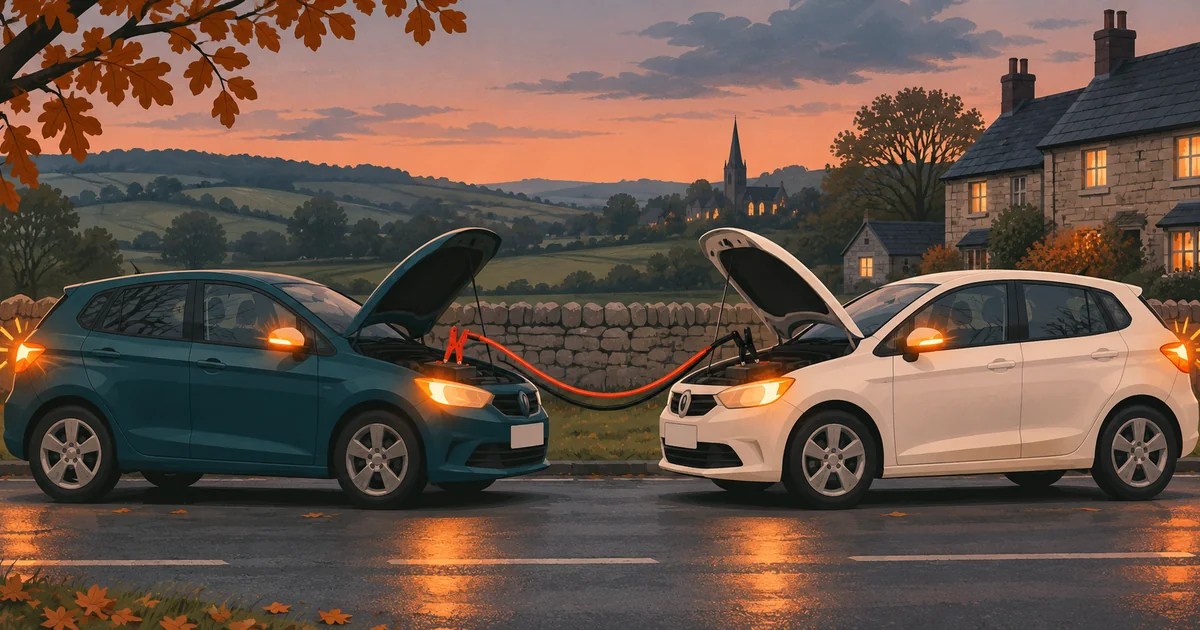
Click, whirr, nothing. A flat battery is one of the most common reasons a car won't start, and the AA lists it among the top 10 breakdown causes. Here's how to tell if the battery really is the problem, how to read a voltage test, how to jump start safely with leads or a booster pack, and what to know before you replace a battery yourself. Procedures vary between cars, so check your owner's handbook first. If it says something different from us, the handbook wins.
We haven't tested these products. This comparison is based on makers' published specifications and manuals, retailer listings and owner reviews (checked 15 November 2026).
Signs your battery is failing
The RAC's flat battery guide and battery replacement page list these warning signs:
- slow engine cranking, or a clicking sound when you try to start
- dim headlights or dashboard lights, or lights that flicker
- problems with electrics such as the radio, windows or central locking
- the battery warning light on the dashboard
- corrosion on the terminals, or (per the RAC's battery change guide) a swollen battery case
Rule out the simple things first. The AA suggests making sure there's fuel in the tank, trying a spare key if the central locking won't work, and checking the wheels aren't jammed against the kerb if the steering lock won't release.
The Highway Code says that if the charge warning light comes on while you're driving, the battery may not be charging. Get that checked soon, because the battery may not be able to keep the lights and other electrics working.
How long do batteries last?
Sources differ. The RAC says batteries typically last three to five years. The AA says most last 5 to 7 years, but that its mechanics see some fail after 2 or 3 because of how the car was driven. Both blame short trips, long periods unused and cold weather. See also how long does a car battery last?
Testing battery voltage
A multimeter or a plug-on battery tester gives a quick health check. Test with the engine off and everything switched off. The RAC gives these readings:
| Reading (engine off) | What the RAC says it means |
|---|---|
| About 12.6 V | Fully charged, healthy |
| Below 12.4 V | Weak |
With the engine running, the RAC's battery voltage guide says you should see 13.7 to 14.7 V, which shows the alternator is charging. A low reading can simply mean the battery is discharged, so recharge it and retest before deciding it's worn out. The RAC also mentions a load test, which checks how the battery holds up under demand, and says many parts stores offer it free.
A simple option is a plug-on tester such as the MOTOPOWER 12V digital battery tester, about £19 at Amazon UK (checked 15 November 2026). Its listing describes coloured LEDs showing battery and alternator status, with reverse-hookup and over-voltage protection.
Jump starting with leads
The AA says it would rather you called a patrol than jump started the car yourself, because leads can harm people and cars if they're used wrongly. If you go ahead, use the method in your handbook. Here are the essentials from the AA's jump lead guide and the RAC's jump start guide.
Safety first
Don't jump start a battery that's damaged, cracked or leaking. Batteries give off flammable gas. Keep flames and cigarettes away, take off rings, watches and other metal, and remove scarves or ties that could catch in moving parts. Stop if the leads get hot.
Donor car: the AA says avoid using a hybrid or electric car as the donor because it could cause damage. The RAC says don't use one unless the maker specifically permits it. Both cars should be 12 volt. On any hybrid or EV, never touch orange high-voltage cables. The MOT inspection manual (section 20) says that's the colour of high-voltage insulation.
You'll need a set of insulated jump leads. One example is the AA AA4550 insulated jump leads, about £14 at Amazon UK (checked 15 November 2026). The listing describes 3 m leads for petrol and diesel engines up to 3000cc, with colour-coded clamps.
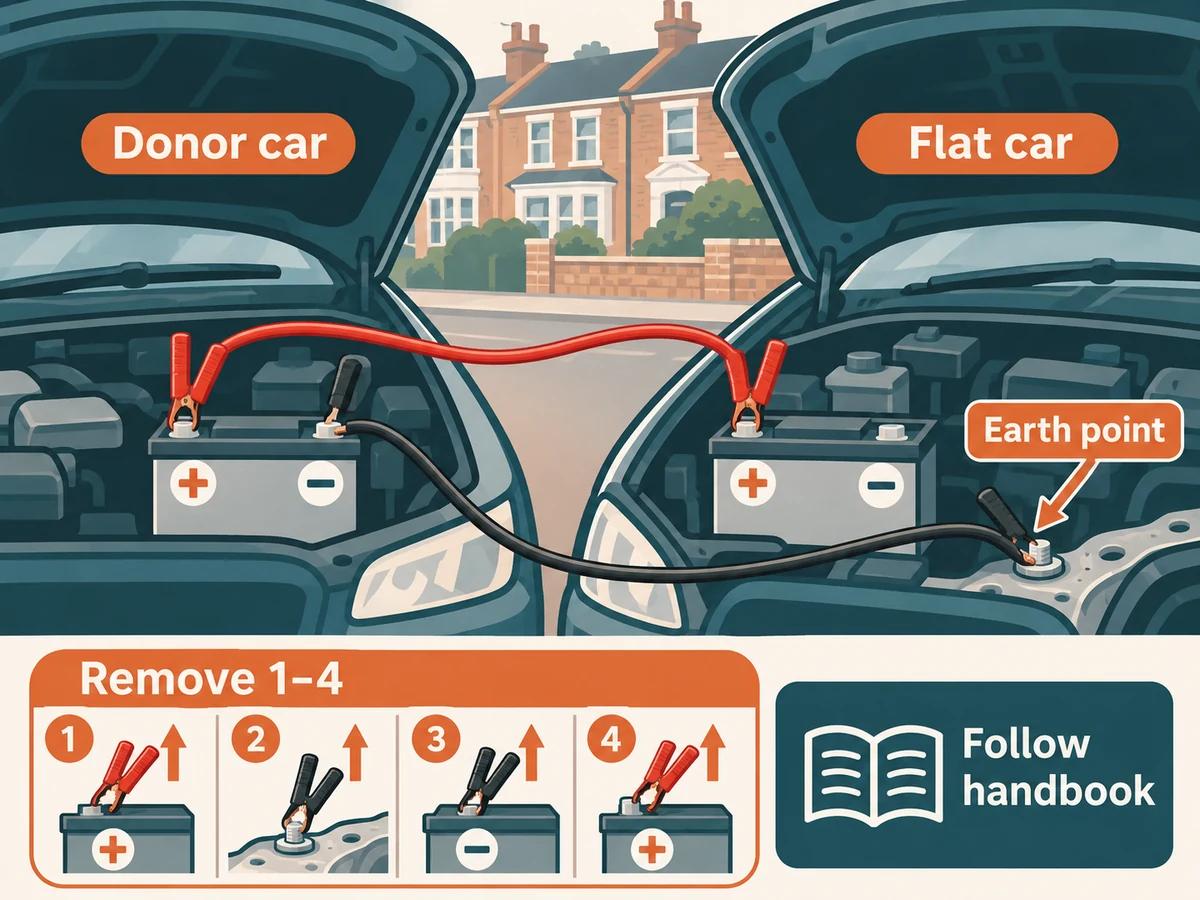
- Park the cars close enough for the leads to reach, without the cars touching. Handbrakes on, ignitions off. The RAC adds: switch off the flat car's lights, radio and other electrics.
- Red lead: connect it to the positive (+) terminals of both batteries. The AA and RAC describe connecting them in a different order, so follow your handbook. Never let the red and black clamps touch.
- Black lead: connect one end to the donor battery's negative (−) terminal. Connect the other end to an earthing point on the flat car, such as unpainted metal on the engine block or chassis, well away from the battery and fuel system.
- Start the donor car and let it run for a few minutes. The AA says wait 3 minutes with both engines off, then run the donor for 1 minute. The RAC says up to 5 minutes.
- Try to start the flat car. The RAC says crank for no more than about 5 seconds at a time, to avoid overheating the starter.
- If it starts, the AA suggests leaving both cars idling for around 10 minutes.
- Disconnect in reverse order: black from the earth point first, then black from the donor, then red from the donor, then red from the previously flat car. The AA says turn both engines off before removing the leads. Removing them with engines running can damage the electrics. Keep the clamps away from fans and belts.
If the car still won't start after a few tries, both organisations say there's probably a more serious fault, so call for help.
Using a booster pack
A booster pack (a portable jump starter) lets you start the car without a second vehicle. The AA's method:
- Put the pack somewhere stable, not on the engine.
- Connect the red clamp to the battery's positive (+) terminal.
- Connect the black clamp to an earth point (unpainted metal on the engine block or chassis).
- Switch the pack on and try to start the car.
- Once running, leave it for about 5 minutes. Then switch the pack off, let the engine run for another 5 to 10 minutes, and remove the black clamp, then the red.
Always follow the pack maker's instructions. Many have their own safety features and steps. One example is the NOCO Boost X GBX45, about £119 at Amazon UK (checked 15 November 2026). Its listing describes a 1,250 A lithium pack rated for petrol engines up to 6.5 litres and diesels up to 4.0 litres, with spark-proof and reverse-polarity protection and USB-C charging. Our jump starter and battery charger guide compares more.
After a jump start
The battery needs recharging. The AA and RAC suggest driving normally, not in stop-start traffic, for at least 30 minutes. The RAC says a proper charge with a battery charger over several hours is best. If the battery keeps going flat, the RAC says it may be near the end of its life, or there may be a fault in the electrical or charging system.
Replacing a battery
Changing a battery can be simple on some cars. But the RAC's battery change guide warns that many modern cars need battery registration or electronic system resets after a new battery is fitted. It says that if you're not confident, a professional should fit it, so you don't lose key functions or damage the electronics. Check your handbook, or ask a dealer, before buying.
Choose the right type
Match the replacement to what your car was built with. The RAC says AGM (absorbent glass mat) batteries suit cars with high electrical demands or stop-start systems, and cost more than standard lead-acid ones. It gives typical prices of £50 to £150 for standard batteries and £100 to £250 for AGM. It puts the average fitted replacement through RAC Mobile Mechanics at £214 (prices paid 1 January to 30 March 2026). Some stop-start cars use an EFB (enhanced flooded battery) instead. Your handbook or the old battery's label will tell you which type you need. If in doubt, ask a parts supplier or garage to match it.
The basic steps (RAC)
- Engine off, key out. Wear gloves and eye protection, because batteries contain acid.
- Disconnect the negative (−) terminal first, then the positive (+). The RAC says don't touch any metal parts with the cable as you move it aside.
- Remove the hold-down clamp and lift the battery out upright. Batteries are heavy.
- Clean the tray, fit the new battery the same way round, and secure the clamp.
- Connect positive (+) first, then negative (−). Tighten both firmly.
- Start the car to check it works, then carry out any registration or reset steps in your handbook.
The RAC says some batteries sit in the boot rather than under the bonnet. The RAC also notes that EVs still have a conventional 12-volt battery for the on-board equipment.
Recycling the old battery
Never put a car battery in the household bin. The RAC says batteries contain hazardous lead and acid, and that retailers, garages, metal recyclers and council recycling centres usually accept them. GOV.UK's guidance on waste batteries says it's illegal to send waste vehicle batteries to landfill or incineration. It also says battery producers must collect them free from places including garages and local council waste sites. Use GOV.UK's find your local council tool to check your nearest household recycling centre accepts car batteries.
FAQs
What voltage means a car battery is flat?
The RAC says a fully charged battery reads around 12.6 V with the engine off, and below 12.4 V is weak. Recharge and retest before deciding it needs replacing.
Can I use a hybrid to jump start my car?
The AA says avoid using a hybrid or electric car as the donor, and the RAC says don't unless the maker specifically permits it. Check the donor car's handbook, or use a booster pack instead.
Do I need a garage to fit a new battery?
Not always. But the RAC says many modern cars need battery registration or system resets after a new battery is fitted. If your handbook mentions this and you don't have the right tool, let a garage or mobile fitter do it.
Sources
- Car battery replacement and fitting — RAC, accessed 15 November 2026.
- What should your car battery voltage be? — RAC, accessed 15 November 2026.
- What to do if you have a flat or dead battery — RAC, accessed 15 November 2026.
- What to do if your car has a flat battery — The AA, accessed 15 November 2026.
- How to jump start a car in 9 steps — The AA, accessed 15 November 2026.
- How to jump start a car in 10 steps — RAC, accessed 15 November 2026.
- How to change a car battery: complete guide — RAC, accessed 15 November 2026.
- Waste batteries: producer responsibility — GOV.UK, accessed 15 November 2026.
- Find your local council — GOV.UK, accessed 15 November 2026.
- The Highway Code: Annex 6, vehicle maintenance, safety and security — Department for Transport, GOV.UK, accessed 15 November 2026.
- MOT inspection manual: introduction — DVSA, GOV.UK, accessed 15 November 2026.
- Amazon UK product listings for the tester, jump leads and booster pack named above, accessed 15 November 2026.